Every year, on the first morning of December, when villages wake under frost and the rooftops shine like glass, I find myself thinking back to a moment when Romania reinvented itself.
A little more than a century ago, in 1918, a handful of historic provinces decided they wished to speak with one voice. Their choice reshaped a country, Romania, but also the map of Eastern Europe and the future of millions.
Most people know December 1 as Romania’s National Day. Fewer know the story behind it; it is one of war, collapse, hope, but mostly of the determined will of ordinary people.
The Turbulent Years Leading Romanian into WW1
Romania emerged as an internationally recognized principality in 1862, three years after Moldavia and Wallachia united under Alexandru Ioan Cuza, the first ruler of the United Principalities.
After Cuza was forced to abdicate, the throne passed in 1866 to the German prince Karl of Hohenzollern-Sigmaringen, soon known as King Carol I, whose arrival in Bucharest marked the beginning of Romania’s modern monarchy. Independence followed in 1877–1878, after the Russo-Turkish War, yet millions of ethnic Romanians still lived under foreign rule in Transylvania, then part of Austria-Hungary, and in Bessarabia, under the Russian Empire.
By the outbreak of the First World War, Romania was a young state with large territorial goals. Its German-born royal house leaned toward the Central Powers, while most politicians and ordinary citizens favored the Entente, hoping the Allies would support the union of Transylvania with the kingdom.
King Carol died on 10 October 1914. The new king, Ferdinand, his nephew (the Romanian Constitution limited succession to the male line and King Carol had no living children), and under the influence of his wife, Marie of Edinburgh – who loved Peleș Castle), was more willing to listen to public opinion and brought Romania into the war on the side of the Allies in 1916. Also, a secret treaty, the Treaty of Bucharest, was signed with the Entente Powers according to which Transylvania, Banat, and Partium would become part of Romania after World War I if the country entered the war.

A Year When the World Cracked Open
Now, to understand why 1918 mattered so much start by imagining a Europe falling apart.
The First World War had exhausted armies, governments, and entire societies. The Russian Empire collapsed followed by the Austro-Hungarian Empire. Out of these ruins nations old and new struggled to define themselves.
Romania, too, was caught in this storm. And its future would be shaped not only on battlefields but in councils, assemblies, and hurried decisions made under extreme pressure.
Bessarabia: The First Province to Step Forward
Our story begins in the east, in Bessarabia (first documented as part of the Principality of Moldavia in 14th century), a strip of land caught between retreating Russian troops and the chaos left behind by the Bolshevik Revolution.
Early in January 1918, the situation grew tense in Bessarabia. Romania’s minister in Petrograd, Constantin Diamandy, was arrested by the Bolsheviks; diplomatic missions in Moscow protested; riots flared as Russian units withdrew in disarray whilethe new Soviet government sent Romania an ultimatum threatening to break all relations. Bessarabia itself was struggling to stay afloat.
Romanian troops entered Chișinău at the start of January 1918, welcomed by a population desperate for stability. Hundreds of volunteers from Transylvania soon marched in to help protect the region. Skirmishes erupted near Fălticeni, while across Bessarabia student groups and civic leaders urged their people to unite with Romania before the chaos swallowed them whole, demanding “a Romania of all Romanians.”
Despite diplomatic threats, ultimatums from the Central Powers, and failed peace talks that demanded impossible concessions, the movement gained strength. By late March, after ceremonies, debates, and royal visits, the Sfatul Țării, Bessarabia’s national council, cast its decisive vote: union with the Kingdom of Romania.
Romania’s King Ferdinand ratified the act in April. This was the first piece of what would become the Great Union. That first step, taken in the cold months of early 1918, lit the path soon followed by the rest of the Romanian historical provinces.
Bucovina, the Last Breath of an Empire
Farther north, Bucovina (included in the Principality of Moldavia in the 14th century) watched the Austro-Hungarian Empire crumble.
By October 1918, its leaders gathered in Cernăuți and formed a National Council. On November 28, just as winter settled on the Carpathians, they voted for union with Romania. Romanian troops, invited by local representatives, entered to secure the province.
Bucovina, too, had spoken(today Bukovina is shared by Romania and Ukraine).

Transylvania. a Great Assembly at Alba Iulia
Already in April 1918, under the presidency of Traian Vuia and by Dr. Ion Cantacuzino, a “National Committee of the Romanians in Transylvania and Bucovina” was established in Paris, campaigning for the unification of Transylvania with Romania. This was followed by a “National Council of Romanian Unity” led by prominent Romanians living abroad: Take Ionescu, dr. Constantin Angelescu, Vasile Lucaciu, Octavia Goga. In the coming months, France, the U.S. and England recognized the Council as representing the interests of the Romanian people.
Meanwhile, in New York, Romanians, Czechs, Slovaks, Serbs, Poles, Ruthenians and Croats held congress demanding the dismantling of Austria-Hungary. In response, Emperor Charles I of Habsburg launches the manifesto “Towards our faithful peoples.” He suggests to organize Austro-Hungary in a federation of six independent states consisting of Hungarians, Czechs, Poles, Yugoslavs and Ukrainians, and Transylvania. But the negotiations failed. The Great National Council in Transylvania, launches a manifesto entitled “Towards the People of the World”, expressing the desire of Romanians to join with Romania.
By November 1918, the entire map of Europe was shifting. The Western Front had reached its armistice on November 11, but in the east the final acts were still unfolding.
Romanian troops crossed the mountains into Transylvania, Muntenia, and Dobrogea as the Central Powers collapsed. Town after town greeted them with relief.
On 19 November priest Ioan Opris was shot by the Hungarian gendarmes in the altar of the church in Critiş because he had the tricolor flag and organized the ceremony of the villagers’ oath of faith to the Romanian flag.
On 28 November 1918 The General Assembly of Bukovina adopts the motion by which it decides “The Unconditional and Eternal Unification of Bucovina, at its old frontier to Ceremus, Colacin and Nistru, on the borders of Romania.”
And so the call went out: a Great National Assembly in Alba Iulia, on December 1, 1918.
On a freezing morning, beneath banners and the breath of thousands rising into the air, delegates from Transylvania, Banat, Crișana, and Maramureș proclaimed their union with Romania. Ten days later, King Ferdinand ratified the act.
The dream of unity had moved from hope to history.
The Last Weeks of 1918 and the First Steps of a New State
December carried the momentum forward. The royal family, headed by Romanian troops, entered Bucharest after two years of refuge in Moldova. At the National Theater in Bucharest there is a show in honor of the allied troops, Maria Filotti reciting “Marseilleza” and Maria Giurgea “The Latin Ginta” by Vasile Alecsandri. Saxon communities declared their support for the union. A new government formed, and on Christmas Eve the official decree confirming Transylvania’s union was issued.
United Romania had begun the serious work of becoming.
Recognition, Loss, and the Shifting Frontiers of Eastern Europe
International recognition followed through the treaties of Saint-Germain (1919) and Trianon (1920).
Yet borders in Eastern Europe rarely rest for long. By 1940, under Soviet pressure, Romania lost territories under foreign pressure, including Bessarabia, northern Bucovina, and southern Dobrogea, reminders that unity achieved once must be defended again and again.
A Capital Rejoices, a Nation Reborn
While Alba Iulia echoed with proclamations, Bucharest celebrated a more personal triumph: the return of King Ferdinand and Queen Marie from wartime refuge in Iași. One famous photograph shows them riding down Calea Victoriei to cheering crowds, an image of monarchy restored and nation renewed.
Four years later, in 1922, they were crowned in Alba Iulia inside a cathedral built especially for the occasion. King Ferdinand wore the steel crown forged from a cannon captured at Plevna, a symbol of independence carried into a new era of unity.
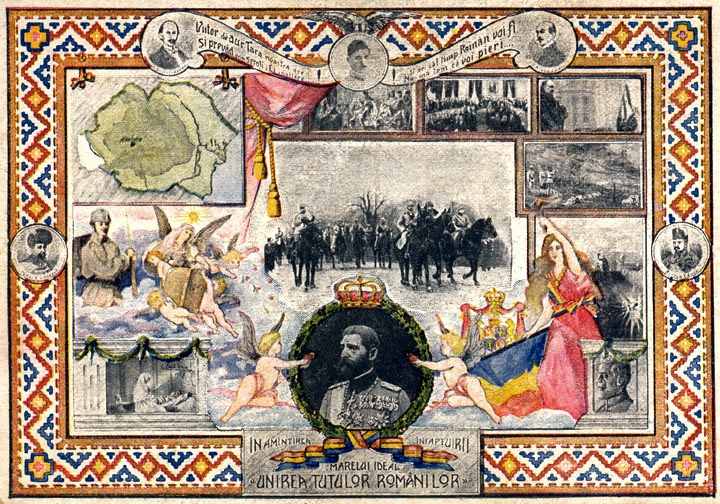
Why December 1?
Strikingly, December 1 only became Romania’s official national day after the fall of Communism in 1989. Before that, national days shifted with regimes:
- May 10 once celebrated the monarchy and independence.
- August 23 marked Romania’s break with Nazi Germany, later overshadowed by Communist propaganda.
Today, December 1 stands for something quieter, deeper, and shared: the moment when voices from mountains, plains, and borderlands rose together and said, We are one.
A Winter Reminder
So when the first snow falls and villages glow under lamplight, I like to remember that unity is never silent. It is argued over, fought for, dreamed into being, and finally – fortune allows – celebrated.
December 1 marks not only a date on a calendar, but a story of becoming.
A century later, its echoes still warm the coldest day of the year.
~~~
Sources:
By Macreanu Iulian – Own work, Public Domain, https://commons.wikimedia.org/w/index.php?curid=44997454
Further Reading:
The Virtual Museum of the Union, a project of the Culture Ministry
The Making of United Romania, Romanian Cultural Institute
That is a lot of interesting history. The dissolution of Austro-Hungary in 1918 was certainly a big event. It reminds of an closer to home for me when Finland, a former Swedish region lost to Russia in 1809, revolted and became its own country (also in 1918). I am wondering about this sentence “Farther north, Bucovina (included in the Principality of Moldavia in the 24th century) watched the Austro-Hungarian Empire crumble.” I assume you mean the 14th century.”
Yes, Sweden I suppose very much the same, Europe is not that big after all… fascinating how history intertwines.
And you are spot on, I amended that 24. 🙂
Have a great December and a Merry and Blessed Christmas, Thomas! Best wishes to you and your family.