In fifteenth-century Transylvania, marriage was not a private affair. It was a public instrument. A legal mechanism. A way of (finally) being seen.
Marriage, or How to be Seen
To marry was to be recorded, witnessed, therefore approved. Then, names were spoken aloud before priests and councils; dowries were listed item by item, while alliances, of course, were fixed in ink and oath. A woman’s body as well as her property and her future —all were folded into a structure designed to be legible to authority – alone. Marriage did not firstly bind; it monitored.
In Kronstadt (modern-day Brașov), a fortified Saxon city ringed by walls and watchtowers, this visibility mattered.
The city lived in a constant state of vigilance against invasion, against heresy, against internal disorder. Private life was never truly private. Marriage functioned as one of the city’s most effective tools of surveillance, ensuring that women were placed, named, and contained, all within acceptable boundaries.
Dowries made this surveillance material. Lists were drawn up before witnesses, recording land, animals, textiles, coins. These documents were meant to safeguard a woman’s contribution, yet they often became tools of control, transferring authority over her property to her husband. What entered the marriage rarely remained hers.
Marriage: a Certain kind of Consent
The law insisted on consent. On paper, a bride was required to agree. In practice, that consent was shaped – often overridden – by fathers, guardians, or communal expectations. Marriages across caste or ethnicity were forbidden. Saxon did not marry Vlach. Catholic did not marry Orthodox. Love, like knowledge, had borders and crossing them carried real danger.
Once married, a woman’s legal identity narrowed. She moved from her father’s authority to her husband’s, becoming visible only through him. Her reputation, her morality, even her work and her faith were now communal concerns. A wife was expected to be obedient, faithful, yet silent. Her virtue was no longer her own; it was something the city watched.
For healers, this scrutiny intensified. Their knowledge placed them at the margins of power – a necessity in times of illness, a suspicion in times of fear. While marriage offered protection, it also bound tighter to oversight. A healer without a husband was vulnerable. A healer with one was accountable not only for her actions, but for her thoughts, her movements, her associations.
In Transylvania, the courts were obsessed with sorcery and women, particularly those living on the fringes of society, were often the targets of witchcraft accusations. The first recorded execution for witchcraft in Transylvania occurred in 1565, when the midwife Carla Botzi was burned alive. By 1593, executions had escalated, with up to fifty women killed in towns such as Cluj and Dej for alleged witchcraft.
Even divorce, though legally possible, reinforced the system. Cases were judged by ecclesiastical courts where morality and obedience weighed heavily. A woman who stepped outside accepted norms risked losing not only her marriage, but her standing, her protection, her place within the city’s walls.
Marriage in medieval Transylvania was not simply a union. It was a checkpoint. A way for church and city to know where a woman belonged, who answered for her, and especially what could be expected of her.
Marriage and the Royal Law of Exclusion
This kind of logic was not abstract. It was written into law.
A fourteenth-century decree issued by King Louis I of Hungary made explicit why women were barred from inheriting land and privilege: property was earned through military service therefore only those who bore arms were deemed worthy to hold it. The reasoning was blunt and devastating in its clarity:
“However, if the question is raised as to why property and rights of land (bona ac iura possessionaria), acquired through service, do not pass to women (ius foemineum non sequantur), the answer is given that this kingdom of Hungary, with its dependent parts, was placed in the midst of and under the claws of its enemies, and it has always been accustomed to be protected and defended with sword and arms, while our ancestors acquired (…) property and land rights (as usual) through military skill and bloodshed (…). However, women and girls are not accustomed to and cannot go to war with weapons and fight with enemies, and for this reason, those goods do not pass to women.”
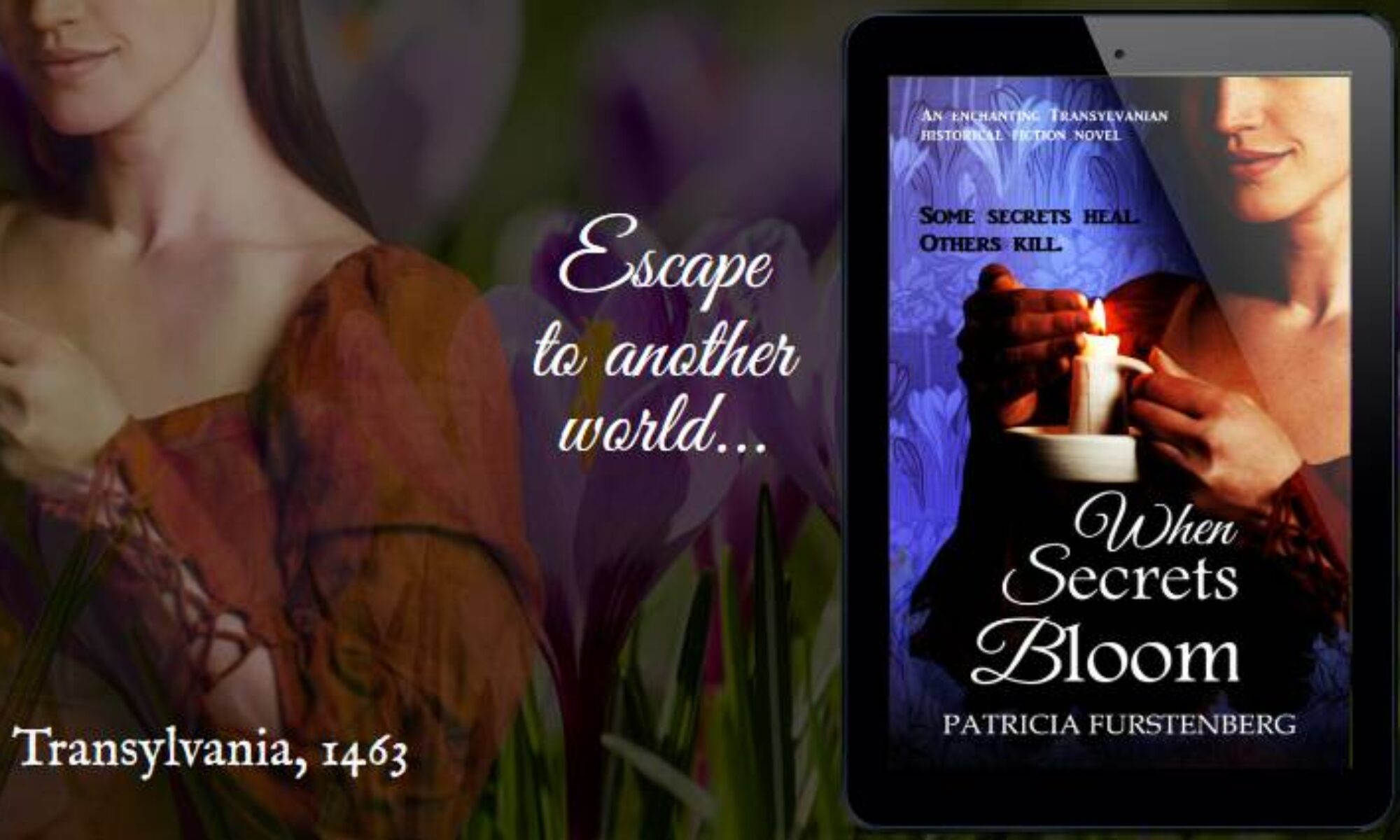
This is the world Kate Webber moves through in When Secrets Bloom. Her choices are shaped by what marriage promises (to a woman) and what and how it threatens her. Protection and exposure. Belonging and confinement. Every tie Kate forms carries consequence, because in fifteenth-century Transylvania intimacy and individuality were never invisible.
This tension forms the quiet spine of When Secrets Bloom.
Reading your post, and I enjoyed it very much, reminded me of the book The Frozen River by Ariel Lawhon. As a midwife/healer, an important community individual we would think, needed her husband to speak for her in a time of community scandal. Isn’t it amazing, and fabulous, those oppressing times are dead?
Certainly. The Frozen River by Ariel Lawhon is a striking story and it was the cover that brought it to my attention 🙂
For the sake of all the young women, it is certainly a blessing that – at least in parts of the world – we can speak for ourselves nowadays. And those who can should definitely try to speak for (or at least about) those who still can’t.
I appreciate your comment.