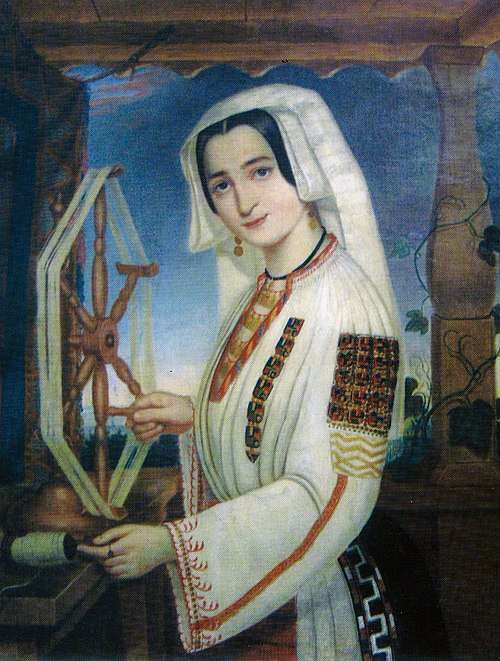
Is, the Romanian blouse, is admired for its beauty, its patterns, and its symbolism. Yet its truest story begins long before the first stitch.
She first pressed the flax seed into earth with her thumb then covered it with soil, one more seed between hundreds she’d planted that morning and one more she’d not remember. There was no reason to. But the field, the land, it would remember. God would remember. Her part was only that, sow and wait, as her mother had done before her. And her grandmother, before that. Trusting rain, when it came; suffering through drought when it didn’t.
She watched the seed disappeared beneath soft dirt.
She watched the place for a moment.
Then she moved on.
There were more seeds in the basket and, ahead, more ground hungry for them. So she bent again because that was the work before her. Sitting and thinking beyond that had never made a field grow.
By midsummer the flax had risen almost to her knees. Blue flowers trembled whenever the wind crossed the valley. The sea must be like that, she thought. She walked among them and thought how fragile they looked, how easily a storm might flatten them. Yet she knew better than to mistake softness for weakness.
She had seen what came of those thin green stalks.
When time came she pulled each one from the earth by hand.
One.
Then another.
And another.
Her shoulders ached before noon. By evening, the ache had settled into her lower back. She knew it would nestle there until morning. When she would rise and begin, again, because the flax would not wait for her to feel rested.
The weeks carried the work along with them. The stalks lay in water until they softened. She spread them beneath the sun. She broke them, combed them, drew the fibres free a handful at a time until the roughness gave way and pale flax gathered at her feet like loose hair waiting to be spun.
When darkness came she sat beside the hearth with her distaff.
The spindle turned.
She watched her fingers more than the spindle itself. They knew how much to draw and when to let go, and they did it before she had thought to tell them. Her mother had taught those hands years ago. Not those hands had remembered even if the lessons themselves already faded.
The thread gathered.
Slowly.
Patiently.
Her daughter slept with her head against the bench beside her. The fire settled lower. Somewhere beyond the house an owl called once and then again.
By winter the loom stood ready.
She passed the shuttle through the waiting threads and listened to the sound the wood made. She listened to its hum over and over. She listened until the room seemed full of nothing else and then she listened some more. She had heard that very hum every winter she could remember. It was the hymn of cold days and short light and of sweet bread rising near the fire, ahead of Christmas.
When the cloth was finished she laid both hands upon it.
It felt cool.
Smooth.
Whole.
Only then did she reach for her needle.

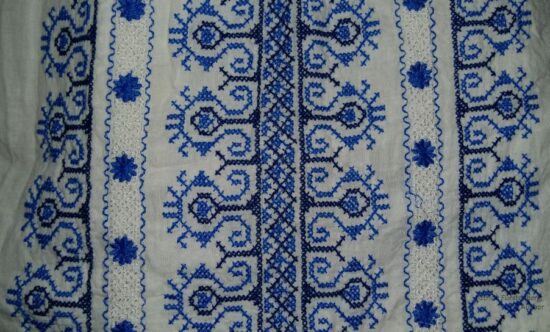
She had been thinking about the embroidery for weeks before she made the first stitch, turning the pattern over in her mind while she fetched water or kneaded bread or swept the floor. Now the linen lay across her lap and there was nothing left to decide.
Only to begin.
She stitched before the sun rose. She stitched after the evening meal. Some days she finished a whole row, her heart singing, before another task called her away and her heart would sin. Other days she looked down at dusk time and found she had made scarcely any progress at all.
Work never hurried just because she wished it to.
It never had.
She wondered who would wear it.
Perhaps her daughter, when she was grown.
Perhaps a sister.
Perhaps herself, if the cloth lasted long enough.
It did not matter yet.
The sleeve in her hands was the only sleeve that mattered. The thread must lie flat. The pattern must meet where it ought to meet. The knot must stay hidden on the inside where no one would see it.
Outside, men spoke of princes and battles. Riders carried news from one town to the next. Someone would always win. Someone would always lose.
Inside, she always stitched.
One stitch.
Then another.
When she tied off the last thread she turned the blouse over and looked at it without smiling. There would be another field in the spring. Another harvest. Another length of linen upon the loom.
But, for now, the work was finished.
Until it will be time to begin again.

Happy 24 June, the International Day of Ia, Romanian Blouse!
Because every ia, every Romanian blouse, begins with a story. Not with the first stitch, nor even with the loom, but with a woman kneeling in a field, pressing a flax seed into the earth.
A fascinating piece, Patricia. Many thanks for sharing. 🙂
Thank you so much, Laura. Ia, the Romanian blouse, is one item that always transports me back home. At least mentally.
I have a Romanian Christmas tablecloth that is so beautiful. We use it every year.
Nicola, thank you for sharing this with me. It made me very happy 🙂 And we have Romanian Christmas table cloths too and cherish them. (I do.)
Such beautiful woven tapestry in your story. I feel the ancient words woven so beautifully here, Patricia. It’s lovely
Ah, you noticed that 🙂 Then I wove the right pattern ♡ Thank you, Cindy.
I sure did and yes you did, Pat.. welcome!!!❣️
So different from fast-fashion, half-plastic, printed designs. What a beautiful method for making unique and precious blouses.
Oh, they are, isn’t it. Unique and so cool in summer too 🙂 Thank you, Priscilla.