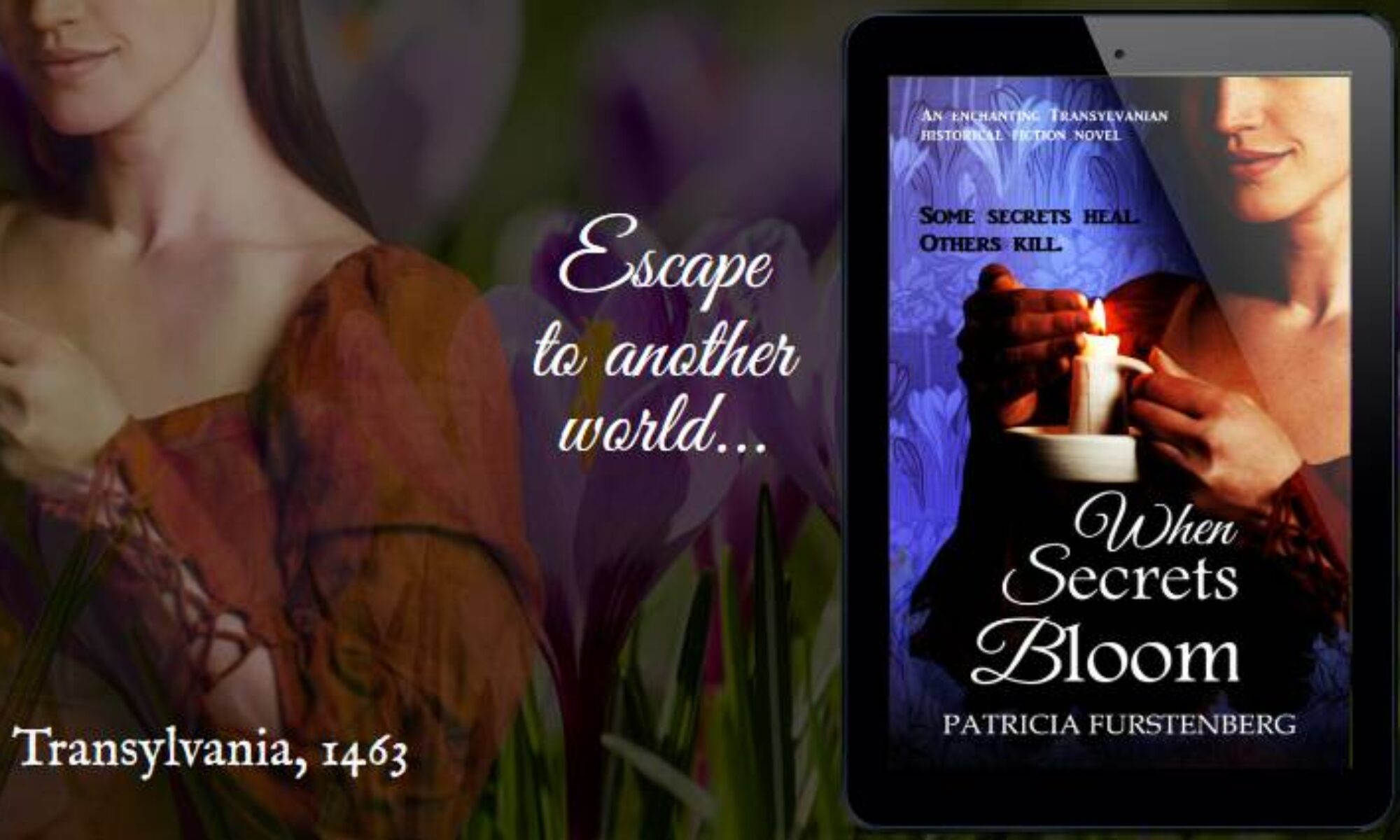

In the frost-bitten winters of 15th-century Transylvania the line between savior and sorceress could be drawn by a whisper. A woman might spend her days easing childbirth pains, binding wounds, or coaxing fevered children back from death only to face the stake by nightfall, accused of witchcraft.
This was the brutal paradox faced by countless women across medieval Europe and perhaps nowhere was it more stark than in the fortified towns of Transylvania, where Saxon, Vlach, Magyar, and Jewish communities shared the safety of walls, but not always trust. Here, a woman’s skill could make her indispensable and dangerous in equal measure.
Popular Women, Healers on the Edge
The women later branded as “witches” were often the first line of defense against sickness and suffering. Many had learned their art in the fields and forests, through herbs and instinct, while others, like my fictional healer Kate Webber in When Secrets Bloom, combined folk wisdom with battlefield knowledge.
These healers were midwives who could turn a breech birth when no physician dared to try. They were herbalists who brewed potions from meadow-sweet and willow bark long before anyone spoke of salicylic acid. And they were confidantes to women with nowhere else to turn, offering counsel in matters of love, fertility, or fear.
Yet these same qualities, so vital to their communities, made them vulnerable.
But the power these women held was not merely medicinal, it was deeply personal, a sisterhood connection. Their knowledge touched forbidden realms: easing childbirth, soothing menstrual pain, even offering ways to delay or prevent pregnancy. In a world where a woman’s body was governed by church and husband, the ability to tame pain, to calm fever, or to quietly control fertility was a radical kind of freedom. What began as folk wisdom was increasingly branded as threat. A poultice for cramps became ‘witchcraft’; a whispered herb for miscarriage, a crime. Miscarriages, poorly understood, were recast as malice..
Healing existed in the hazy borderlands between science and superstition. A successful remedy was a “miracle” – until it failed or until the healer crossed a powerful man. Then, it became “witchcraft.”
Though most of these women sought only to heal, their knowledge walked a perilous line. In the eyes of their neighbours, the very remedies they used could easily be reimagined as weapons. A tonic that failed became a poison. An herb tied above a cradle, protection to some, looked like a curse to others. Medieval people knew that the same hands which set bones could also, if they wished, stop a heart. And so suspicion thrived in ambiguity: if a woman could cure, then surely she could also kill. Better, some muttered, to fear her than to trust her.

The Politics of Fear
By the mid-15th century Transylvania was no stranger to political tension. Hungarian kings, Ottoman threats, and local ethnics and guild rivalries created a volatile mix of fear and ambition. And fear, history teaches us, is fertile ground for witch hunts.
Midwives and healers were easy targets. They were women gaining influence in a deeply patriarchal society. Their knowledge existed outside the sanctioned university system, which was closed to them. And their work, especially in childbirth and women’s health, placed them at the heart of life-and-death moments where outcomes were never certain.
When a mother or child died in childbirth, grief demanded a culprit. When a harvest failed, when livestock sickened, when a wealthy man sought to rid himself of a troublesome wife, the answer was the same: the healer, the witch.
Sometimes the accusations were rooted in malice. A husband could gain a widow’s inheritance by ensuring his wife never left the courtroom alive. A physician could silence a skilled competitor by turning the town against her. And, sometimes, as in the witch trials of Kronstadt (Brasov) and Hermannstadt (Sibiu), entire communities were swept up in hysteria.
From Secrecy to Betrayal
Accusations often arose not from spells, but from secrecy. Medieval healers worked in private, using whispered remedies, rushing to night visits, using hidden or hard to get herbs (or some gathered under special conditions).
And secrecy, in a fearful society, bred menace. It was enough for a neighbour to claim, “She muttered over my sick child,” and suddenly a healer’s silence became proof of sorcery. Relationships with clients could turn deadly; when remedies failed or favours soured, it was easy to betray the very woman once begged for help. The danger was not only in healing, but in being known as one who wielded unseen knowledge. A book of herbs, a guarded recipe, even a careless threat spoken in anger, any crack in secrecy could be twisted into evidence of witchcraft.

Love, Magic, and Emotional Control
If a healer’s herbs could touch the body, rumours whispered that her words might reach even further: into the chambers of the heart.
Perhaps nothing stirred deeper fear than the belief that such women could command not only the body, but the heart. Witchcraft was feared not only for harm to the body, but to the heart. Whispered rumors spoke of charms to inflame desire, powders to turn a husband’s gaze, oils to cool a lover’s touch, spooked tools to break a marriage.
A salve slipped into wine could be called a tonic, or a trap. Medieval men feared that, with a kiss or a blessing, a woman might bend a household, a marriage, even a lineage to her will. Love magic, no less than poison, was seen as an assault: invisible, intimate, unforgivable.
If love could be bent, what of the land itself? What if she who swayed a husband could also sour a herd or summon a storm?
Nature Magic
There were women, they said, who did not merely curse a neighbour — they soured the very milk in his pail — a stark example of how the transformation of attitudes turned harmless folk beliefs into acts of diabolical witchcraft.
Church walls in the north still bear their images: bent figures with crooked spoons, demons crouched at their shoulders, churning butter no cow had given. A cow that bled instead of giving milk, a storm that broke the wheat just before harvest, such things could not be met with reason. They were warnings. In a village bound to the mercy of seasons, to spoil milk or summon hail was no petty mischief. It was treason against God’s own order.
To be accused of killing livestock was to be accused of striking at survival. And when the same hands were believed to twist weather (be it call rain out of season or fling hail like stones) terror deepened. For what defence had a ploughman against a neighbour who could command the sky? To hex a cow was a crime. But to command the wind, that was blasphemy.
Necromancy, the Ultimate Fear
Yet the darkest fear did not dwell in the cottage, but in the sacristy. There were whispers not of hedge-witches, but of learned men, clerics, who drew circles in candlelight and summoned spirits with psalms. They called it angelic art, necromantia, claiming to seek knowledge. But the faithful saw betrayal. For if a priest, keeper of sacraments, could kneel not to Christ but to a hidden voice in the dark, what safety was left?
Such magic spoke Latin, wore vestments and invoked the names of saints even as it fed on doubt. It promised treasure, prophecy, love – yet always at a cost. A hedge-witch might steal milk. A necromancer stole souls. And perhaps that is why people feared them most: not because they denied the sacred… but because they used it.

Networks of Resistance
And yet, these women did not always go quietly to their fates. Across Central and Eastern Europe, evidence survives of secret networks of women (midwives, widows, nuns, and even wives of magistrates) who offered sanctuary or testimony to protect the accused. They exchanged coded messages, bribed guards, or spread misinformation to confuse the authorities.
Some, like the fictional Kate Webber in When Secrets Bloom, escaped their executions entirely, vanishing into forests or remote valleys where they continued to heal in secret. Others stood trial and refused to confess, forcing their accusers to reckon with their own lies.
What emerges from these stories is not a tale of superstition alone, but one of resistance. Of women who clung to their knowledge, their dignity and their right to help others in a world determined to push them aside, to silence them.
A Kingdom Divided, a Fear Unleashed
Witch-hunting in the old Kingdom of Hungary of which Transylvania was a restless, shadowed two thirds, never reached the fevered cruelty of Central Europe. Still, it simmered steadily through centuries of turmoil. Accusations rose not in orderly courts, but among villages split by faith, empire and shifting rule.
After the fall at Mohács in 1526, the land fractured: the Turks claimed the plains, the Habsburgs held Upper Hungary, and Transylvania stood apart as an almost-independent principality. In these borderlands of uncertainty, where three powers watched one another over drawn swords, fear found other enemies.
Most of the accused were women: healers, widows, midwives, those who lived at the edge of fields and custom. Some were banished, others scourged; only a portion were led to the stake. In Hungary, witchcraft was a social wound more than a spectacle. Communities punished as much as they feared, seeking order in a world threatened by plague, foreign armies, failing harvests, and unseen curses.
It was not mass hysteria, but a long, low dread rooted in the everyday. And in Transylvania, where tongues spoke Hungarian, German, Romanian, Romani and silence, the question asked the loudest was never “Is she a witch?” but “What price has been paid for peace?”
Legacy of “Witches”
Centuries later historians have begun to reclaim these so-called witches for what many truly were: healers, scientists, and guardians of knowledge. Their work, dismissed as ‘magic’ by fearful men, prefigured medical practices that would later become mainstream. Yet as universities barred women and medicine turned professional, the very knowledge these women once nurtured was seized and claimed by men.
Today, their stories – fictional and historical alike – reveal not only the dangers they faced but also the strength and solidarity that sustained them. Their legacy reminds us that witch hunts were rarely about spells and sorcery. They were about control. They were about silencing women whose knowledge threatened entrenched power. And, above all, witch hunt was about fear: fear of the unknown, fear of change, fear of women who knew more, could do better, and simply refused to know their place.
But these women endured. Some vanished into the mists of history. Others left traces in court records and charred trial documents. And through their defiance, every baby delivered, every fever broken, every life saved in secret, they shaped our world in ways their persecutors could never imagine.
In When Secrets Bloom, my book baby, that lost courage rises again in women who heal, defy, and risk everything against a world bent on their silence.

Biography / Further Reading:
The Oxford Handbook of Witchcraft in Early Modern Europe and Colonial America edited by Brian P. Levack
Witches and Neighbours by Robin Briggs
Fascinating information! Thanks.
Thank you, Darlene. Glad you found it useful.
The dark ages were indeed dark. So much superstition, ignorance and cruelty, and women were terribly oppressed. You wrote a very interesting and important essay. We should not forget how life can be when ignorance and magical thinking rule the day.
Thank you and you’re absolutely right. What seems like distant history warns us how quickly fear can turn to cruelty, especially toward women whose knowledge threatened power. In those society not inclined to embrace superstition or natural remedies, their skills were too often met with suspicion rather than gratitude.
Such an interesting post, Patricia! You always open my eyes to very interesting topics from such a unique perspective. Thank you so much for sharing.