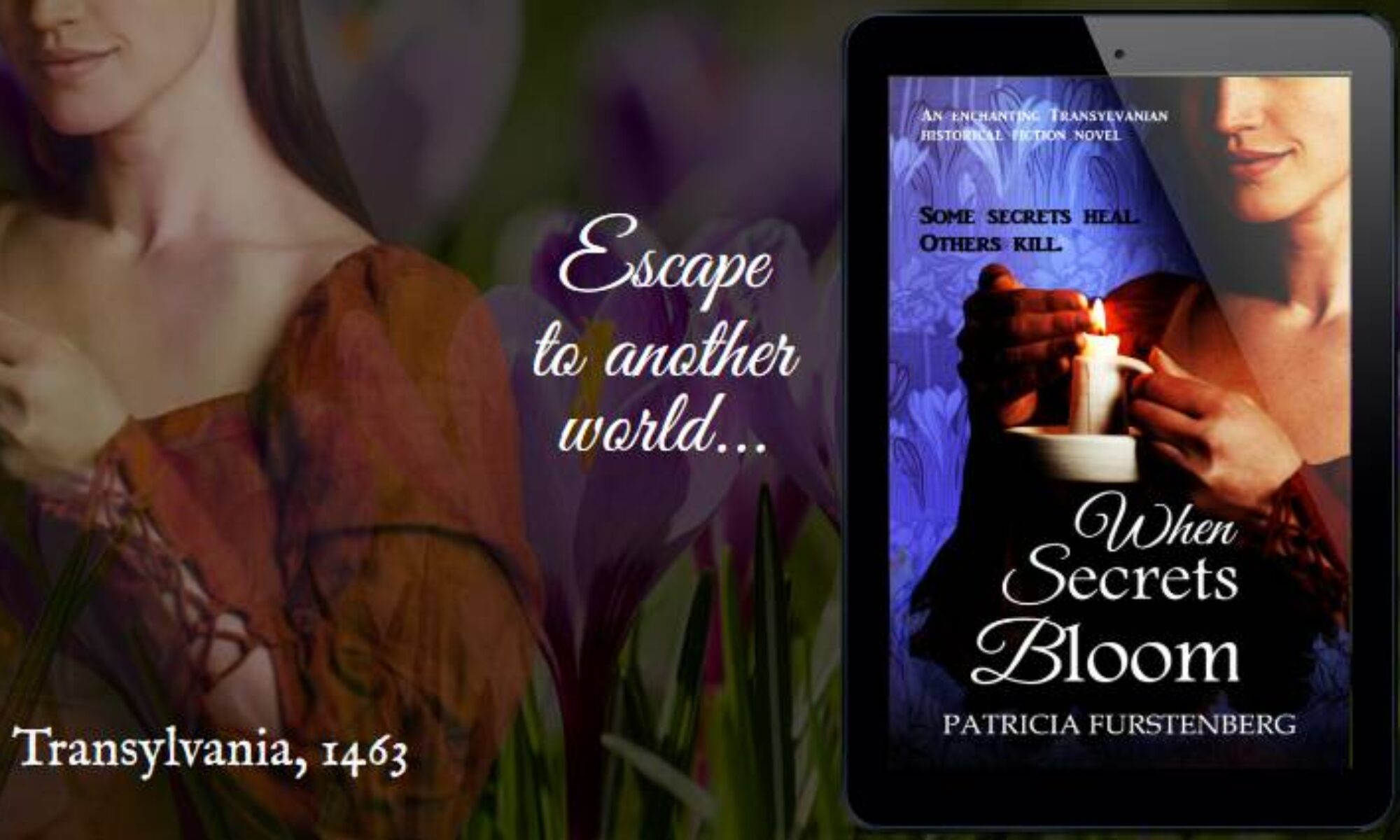

I never intended to write women who refuse to follow the norms, radical women who refuse to disappear. But I continue to find them.
Or maybe they keep finding me.
There’s something about a lady who refuses to give up. A lady who bends without breaking. Who may be crushed by the weight of expectation—wife, healer, servant, mother, soul—but will not disappear.
These are the women who I write about. Because history has often attempted to eradicate them.
Take Kate Webber, the German Saxon midwife-turned-accused from When Secrets Bloom, book one in my current series set in 15th-century Transylvania. She is a healer, not a fighter. She listens more than she talks. However, when the patriarchal world’s walls shut in, she transforms into something else: a survivor.
In Book One, When Secrets Bloom, Kate is drawn into an unintentional conspiracy. She faces treachery, mistrust, and the harsh edge of whispered gossip—but she risks all to save a life.
In Book Two (coming out this year!), we find her in a wilderness, chased and alone, but yet determined not to give up. And find that elusive truth. Guard what she swore to protect.
By the third book, she is negotiating a castle’s stone-cold politics, putting together secrets that others have killed to keep concealed.
In Book Four, she manages to survive yet again. Not because the world creates space for her, but because she takes it.
Much like the Queen in the game of chess.
Nowadays, the Queen is the most powerful piece on the board. However, this was not always the case.
Between the 10th and 15th centuries, Europeans gradually changed the rules of chess, widening her reach—reflecting the true development of queens who reigned in their own right, commanding courts and shaping history to their whim. The game modified to recognize their presence. Power, once reserved for monarchs and bishops, began to shift. And it did it silently and slowly, on the back of a moving woman.
Kate is no different. She does not grab authority by violence. She calculates, sacrifices, and outlasts. She does not crash through the door. She finds the key. Sometimes she is the key.
Women like Kate are not oddities. They are reflections. They are echoes of innumerable real women throughout history who, rather than using swords, challenged the status quo via silence, disobedience, and impossible decisions.
I write about women who plan and smuggle hope through shut doors like Gertrud, the physician’s wife in When Secrets Bloom.
Women who scheme beneath wimples and veils (her secret sisterhood of Kronstadt women).
Women who conceal herbs beneath their skirts, not for evil, but for mercy.
I write about women who manage to escape—not usually physically, but mentally (Esther, Moise’s sister.
Some are quiet, like Kate, who observes before acting.
Others are outspoken, loud, and impossible to ignore (the Afghan women from my geopolitical novel Silent Heroes).
But they all have the same fire: the determination to survive in a world that wasn’t made.
Let us be honest. Being a woman has always been a perilous occupation.
In the medieval era, surviving childbirth was a coin toss. Speaking too freely could result in the death penalty. Standing too tall may incite the flames.
But even now, in the boardroom or on the street, we know how it feels to have our safety, sanity, and dreams continuously balanced against someone else’s comfort.
So, when I write, I’m not just telling stories. I bear witness.
Because history did not happen without women.
We were there—in the shadows, kitchens, chapels, alleys, and woodlands. We were there with blood on our hands—not only from battle, but from birth, labor, and survival.
I once heard someone say, “You can’t kill a woman who remembers.”
That’s why I write these women.
To remember.
To remind.
To resist.
Kate and the ladies who accompany her in my historical fiction stories do not wield armies. However, they do wield truths—about justice, trust, pain, and love. They face betrayal. They learn to trust and avoid certain people. They don’t always win. However, they will not go away.
In chess, the Queen’s power lies not just in her strength, but also in her mobility—her ability to go into space no one thought she could, and to reach across the board in ways the King could not.
In my stories, women do the same.
In a world that still tries to hush women with politeness, to sideline them with history books full of kings and generals, I choose to write the footnotes into full chapters. I give the so-called “witches” names. I give the wallflowers voices. I give the “fallen” their own rise.
And perhaps, in doing so, I offer a small reminder:
The dragons may still exist.
But so do the women who remember how to slay them.
And like a Queen crossing a battlefield of pawns, they do not ask for permission.
They move.
And the game changes.
New Release on Amazon and on Kindle Unlimited. Click on the image:

That sounds like a great series and I think that is an excellent theme. I have to admit I did not know that about the Queen in chess.
Thank you, Thomas.
Yes, the history of chess and its rules is fascinating.
Oh, what a lovely post about the strength of women, Patricia. “We know how it feels to have our safety, sanity, and dreams continuously balanced against someone else’s comfort.” That rang true as well as the fact that women are survivors, movers, change-makers.
The women in your book captured my imagination, and I enjoyed their scenes the most. Your care for their stories shone through. It was great to hear that this is a tetralogy! <3
Thank you so much, Diana. That means so much to me, especially coming from someone who understands the power of story so deeply.
I’m so glad the women from my book post resonated with you 🙂 Their unexpected but quiet strength shaped the heart of the book, and there’s more of their journey still to come. How else! 😉
I’ll be posting my review tomorrow!
Woo-hoo! 🙂
The background and motivation for your characters sounds empowering and real Patricia.
Hi Brad, so excited you noticed that. It was extraordinary to research the life and (lack of) rights as well as the power (truth be told) women living in the Romanian Principalities during the 15th – 18th century centuries had. I embarked on this research with what I thought was a hefty amount ot knowledge. In the end, I doubted my abilities to survive during that time. So I tried to do it for them.
Great post! Very well written. Thanks for sharing