
History does not always unfold in grand theatres. More often, it is decided in narrow waters, in the press of cannon smoke, in the brutal exchanges where survival is measured not in glory, but in seconds. When history is reduced to a single moment of fire and impact, what remains of the men who stood within it?
Antoine Vanner is one of the contributing writer to our historical fiction anthology Courage: Tales of History, Mystery and Hope.
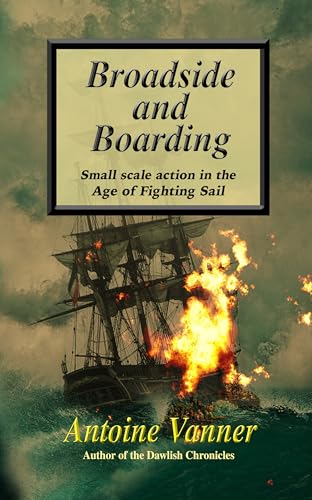
Historical fiction Broadside and Boarding is a collection that strips the Age of Fighting Sail down to its most elemental form. Here, there are no distant admirals dictating fate from polished decks . Instead we are drawn into the raw immediacy of smaller actions: frigates duelling in isolation, boarding parties clashing under lantern light, crews tested by storm and fear as much as by the enemy before them.
Each account reads like a contained storm story. Lieutenant, midshipman, gunner — these are the figures who carry the narrative. They are not mythic heroes, but rather men driven by duty, desperation and often a thin thread of resolve stretched to breaking point. Their victories are not inevitable. They are often wrested from chaos, one decision, one broadside at a time.
What stands out most in Broadside and Boarding is the balance between research and narrative force. The historical grounding gives weight to each encounter, while the storytelling ensures immediacy. You feel the recoil of the guns, the splintering of wood, the confusion of close-quarters combat where visibility is limited and survival uncertain. There is a particular honesty in these stories. Victory is rarely clean. Loss is never abstract. Even in triumph there is cost. And yet, within that cost, there is a fierce will to endure. This must be the defining trait of those who lived and fought in this era.
This exploration of endurance, of what individuals carry through conflict and consequence, echoes the themes I return to in When Secrets Bloom. Though set in a different time and place, the question remains: what is revealed when pressure is applied and what is lost when it becomes too great to bear?
Broadside and Boarding is not about the scale of empire, rather it is about the individuals who shaped it in moments that rarely made the history books. It reminds us that history is not only written in sweeping narratives, but in fragments, brief yet decisive, that are often forgotten. I found it to be an admirable, entertaining read.
And so the question lingers: when history is reduced to a single moment of fire and impact, what remains of the men who stood within it?
Antoine Vanner has survived military coups, a guerrilla war, storms at sea and life in mangrove swamps, tropical forest, offshore oil-platforms and the boardroom. He has lived and worked long-term in eight countries, has travelled widely in all continents except Antarctica and is fluent in three languages. He has a passion for nineteenth-century political and military history and has a deep understanding of what was the cutting-edge technology of the time.
#HistoricalFiction #NavalHistory #BookReview #TuesdayBookBlog
Smoke, Steel, and the Measure of Men
We need books like this to remind us of war’s horrors and the courage of those who fight, especially in an age where pushing a button to control a distant drone increasingly defines combat. Have added to my TBR list. Thanks for showcasing this important perspective.
Yes, I felt the same when I picked up Antoine’s book. The research he did was impressive as well. I have a personal interest in battles and how war affects humankind, especially PTSD gow we understand it now, but was overlooked for hundreds of years. This books was fierce.
Just adding a comment to yours, Patricia, about PTSD. Writing about the English Civil Wars made me realise how half the population (who survived) were walking around with some form of PTSD, and when my central character was described as “arriving drunk in parliament” most days, I knew why. I also kept “All Quiet on the Western Front” on my desk as my go-to read. War is war, sadly. I think Antoine covers this brilliantly in his short story for Courage.
Sad findings is all I’ll say. And war dogs develop PTSD too, Elizabeth. Thank you for adding sucj insightful information to the other comments.
I love books like this, Patricia; history from the perspective of those who fought it. I had an ancestor way back who joined the British Navy and was in a sea battle the day after he joined. He survived that, and as far as we can tell became the ship’s cook – but he still had to fight when engaged by the enemy. His is an interesting story, just one of many, so it’s good to have books like this to remind of them. Thanks for sharing. 🙂
What an extraordinary life, Laura! It teaches us something else about ourselves whenever we discover a story from our ancestors past, isn’t it. Thank you for sharing.
You’re welcome, Patricia. 🙂
Years and years (and years!) ago I had a computer game called “Broadsides” that was about ship-to-ship combat during the Age of Sail. Of course, it looks incredibly crude by today’s standards …
https://en.wikipedia.org/wiki/Broadsides_(video_game)
Many… many years ago I used to play battleship with pen and paper. We would use math paper as it had ready-made squares and number two large ones, 8 x 8, with letters and numbers. One large square would be my fighting field where I would place my ships. The other, the oponent’s. Luckily for math homework books. Otherwise we would draw 8×8 squares. I loved it. 🙂