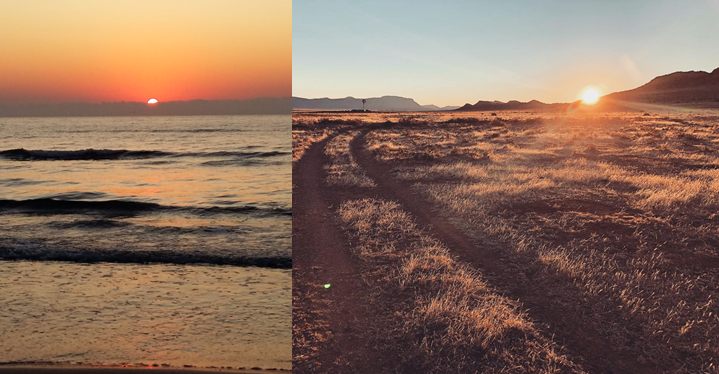
There are places that tourists visit, photograph, and then forget. And then there are those places that get lodged in your heart for years. Like the sound and the sight of the sea just before dawn or the smell of smoke caught in a jacket long after the fire has died.
Vama Veche on the coast of the Black Sea, Romania, and AfrikaBurn in the Tankwa Karoo, South Africa, are such spaces.
Vama Veche sits at the edge of the Black Sea, where Romania exhales into Bulgaria beneath salt wind and old rock music. AfriaBurn rises from dust in the heart of the Tankwa Karoo, where the desert swallows roads, shadows, and certainty alike.
Seaweed and grilled fish, cheap beer and sunburned shoulders against dust storms and diesel, wood smoke and the strange metallic scent of a desert before dawn. Nothing much in common, right?
Yet between them lies the same hunger.
The hunger to step outside an ordinary life and remember who you are when no one is watching. One year of civilization finally converged into the sound of waves and the freedom of speech.


Vama Veche: Romania’s Defying Memory
Before influencers discovered it, before hashtags and drone footage here was simply: Vama.
A village at the edge of Romania where people arrived with backpacks, guitars, sleeping bags, and very little money. A place where nobody cared what car you drove because half the people arrived by hitchhiking anyway.
My generation inherited stories of the old Vama Veche from the 1970s and 1980s like fragments of mythology.
Students sleeping in tents beneath the stars.
Artists escaping Security surveillance and concrete apartment blocks.
Philosophy discussed at sunrise beside fires that burned until the sea breeze carried the last sparks away.
You walked there dusty and exhausted after getting dropped outside Mangalia. You crossed railway tracks, military zones, empty fields and, suddenly, the world opened.
Not luxury. Never luxury.
Freedom.
The kind that cannot be bought because it exists precisely where money loses importance.
You slept in courtyards overrun with grapevines and apricot trees. Elderly hosts brought scovergi (flat doughnuts), homemade jam, and cold well water. The enamel mugs were chipped. The tablecloth smelled faintly of sun and dust. Someone always had a guitar.
But, somehow, everyone belonged.
On the beach, one sunburned humanity. Volleyball games beside driftwood fires. Beer bottles buried neck-deep in sand. Long hair tangled by the wind. Boots and bare feet. Music leaking softly from makeshift wooden bars that were built more from stubbornness than architecture.
There is a Romanian phrase people often use about Vama: “Te oprește din fugă.”
It breaks your chasing.
You arrive carrying noise inside you. The sea slowly erases it.
AfrikaBurn: a Civilization in the African Dust
Years later, something impossible too shape in the desert.
Every year since 2007 thousands of people gather on Quaggafontein Farm, roughly halfway between Ceres and Calvinia, to build a temporary city called Tankwa Town.
For one week nothing behaves according to normal rules. You arrive. You contribute simply by giving back.
That’s it.


At AfrikaBurn feels lights drift through dust storms. Giant mutant vehicles shaped like unicorns, pirate ships, or glowing mechanical beasts crawl across the desert floor. Music appears and disappears with the wind. In the darkness flamethrowers erupt toward the stars.
You lose all sense of direction. That is part of the point.
AfrikaBurn strips away the illusion that modern life is permanent. The city exists for a few days only because people collectively imagine it into existence. Then it vanishes again into silence.
No shops. No advertisements.
You bring all that you need to survive: water, food, shelter, medicine, lights, bicycles, sunscreen, patience. Music.
And gifts.
Because AfrikaBurn runs on generosity.
Someone offers iced coffee during a dust storm. Someone repairs your bicycle without asking for payment. Someone paints your face beneath a sky crowded with impossible stars. Someone hands you soup at 3 a.m. because they noticed you looked cold.
It sounds naïve until you experience it.
Then you realize how starved modern society has become for spaces where human interaction is not immediately transactional.
Life Needs Saltwater and Dust
The sea and the desert are opposites.
The Black Sea enfolds you. The Tankwa Karoo desert tests you.
At AfrikaBurn, the environment itself feels biblical. Scorching heat during the day. Freezing nights. Dust storms so thick the world disappears into white static. You carry water the way medieval travelers guarded wine.
Five liters a day, minimum. But it better be enough.
Meanwhile, at Vama Veche, life revolves around surrender. Salt drying on your skin. Sunlight settling into your bones. Endless afternoons where time dissolves into waves and laughter.
Yet both places ask the same dangerous question:
Who are you without routine?
Without deadlines?
Without hierarchy?
Without the endless machinery of buying and selling?
Most people do not realize how exhausted they are until they enter a place where exhaustion is no longer treated as normal.

The Fire Within Matters
Both Vama Veche and AfrikaBurn understand something ancient about human beings:
We need ritual.
At Vama, people gather around beach fires while guitars echo into the darkness. You sing songs you forgot you remembered. The sound of waves strikes the shore in the rhythm of your heartbeat.
At AfrikaBurn, massive art installations burn against the desert sky while thousands stand in silence watching months — sometimes years — of work vanish into flame. To an outsider it can seem absurd. Why build something beautiful only to destroy it?
But perhaps that is precisely why it matters.
Modern society obsesses over permanence. Saving. Archiving. Branding. Monetizing.
Yet some experiences become meaningful precisely because they disappear.
A sunrise over Vama Veche after dancing all night.
A wooden giant collapsing into sparks beneath the desert moon at Tankwa.
These moments resist ownership. You can only live them.
What Romanians and South Africans Understand
Romania and South Africa are wildly different countries, born from different histories and scars.
Yet both understand longing. Both understand survival.
In both cultures people created spaces where they briefly escape the systems.
In communist Romania, Vama Veche became a refuge for bohemians, rebels, artists, students, and wanderers searching for air beyond conformity.
In post-apartheid South Africa, AfrikaBurn became a place where self-expression and temporary community flourish beyond the ordinary architecture of race, class, and commerce.
Neither place is perfect. Both have changed. Both wrestle with commercialization and popularity.
But their essence endures because the need they answer is eternal. Human beings ache for places where they are allowed to become porous again.
Places where strangers smile at each other. Where music matters more than status. Where the stars are visible and part of daily life.
Places where people remember how to share without expecting return.

Perhaps That Is Why We Keep Returning
Every year people return to Vama Veche.
Every year people cross hundreds of kilometers of brutal Karoo road toward AfrikaBurn.
Something, there, reminds them they are alive.
The sea at Vama still whispers the same thing it whispered decades ago beneath communist skies.
Slow down.
Come closer.
Remember yourself.
And in the Tankwa desert, beneath fire and dust, AfrikaBurn asks another question entirely:
If we can build a kinder world for one week, in the middle of nowhere… why not elsewhere too?
Hi Patricia, this is an interesting article. I learned about this place at the Black Sea. I’ve heard about AfrikaBurn but not experienced it.
Vama Veche (The Old Border) was this unplugged zone before cellphones were enven invented. It was magical 🙂
The Burning Man that AfrikaBurn centers on is originally an American concept, I learned recently.