
There are endings that close a story and there are endings that open something far larger, echoing like footsteps across a void road. When an empire falls what truly ends… and what quietly survives?
Within our historical fiction anthology Courage: Tales of History, Mystery and Hope Marian L. Thorpe shares a remarkable story.
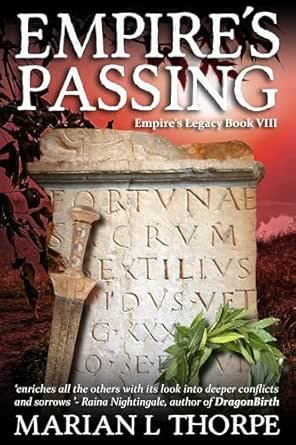
Historical fiction Empire’s Passing by Marian L. Thorpe definitely belongs to those endings that open something far larger.
This final volume in the Empire’s Legacy gathers the threads of a once-mighty Eastern empire as they begin to unravel. Power shifts, alliances fracture, and the illusion of permanence gives way to an inevitable tide of change. What remains is not triumph but rather consequence and the difficult task of continuing when the world you once understood has already begun to dissolve.
At the centre of Empire’s Passing stands Gwenna, now carrying the weight of leadership. Hers is not a role defined by certainty but by endurance. Grief shadows her decisions, shaping each step through hesitation. Leadership, in this telling, is not authority but burden. And Gwenna bears it with a strength that is neither loud nor absolute, but deeply human.
There is a deliberate attention to the architecture of power throughout the novel. Strategy, alliance, and foresight are not abstract concepts, all are survival . Much like the game of xache woven into the narrative, each decision demands patience and precision. One misstep, one overlooked move, and the consequences ripple outward reshaping the board entirely. The tension lies not only in action but in anticipation, in what is planned as well in what cannot be foreseen.
And yet, beneath the shifting borders and political manoeuvres, the story remains grounded in something far more enduring: the persistence of human connection. Love, loyalty, and memory do not vanish with the fall of an empire. They adapt. They endure. They find ways to exist even in the shadow of loss.
It is this balance between the vast and the intimate that gives the narrative its depth. Life and death are not treated as opposites, but as continuations of the same quiet cycle. What begins must, eventually, end. And what ends leaves behind something that cannot be easily erased.
That idea resonates closely with my own exploration in When Secrets Bloom, where the past is never truly past and where what is carried forward, whether remembered or hidden, continues to shape the present in subtle, enduring ways.
By the time Empire’s Passing reaches its final page, it does not feel like an ending so much as a closing of distance. The reader has not simply followed a story but enjoyed walking alongside it, through its years, its losses, and its unforgettable moments of resilience.
The question that remains is: when an empire falls, what truly ends… and what quietly survives?
BUY LINKS: Amazon US / Amazon UK
Marian L. Thorpe writes “novels that are historical fiction of an imagined world, one that is close to Britain, Northern Europe, and Rome, but isn’t any of them. Her short stories – either in multiple-author anthologies or my own collection – range from urban fantasy to historical fiction, slice-of-life to climate fiction.”
#HistoricalFiction #EpicFantasy #BookReview #TuesdayBookBlog
Thankyou, Patricia! You saw what I was trying to do with the overall story, which means I succeeded — always a relief! And when An Unwise Prince and its sequel eventually see the light of day, what has ‘quietly survived’ will be revealed.
Whoops! replied from the wrong WordPress account 🙂
I am sonl happy you feel this way, Marian. Always a joy to get the book 🙂 With greatest pleasure and I’ll be looking forward to the sequel.
Empire’s Passing sounds an intriguing and thought-provoking novel, with some strong (and perhaps eye-opening) analogies to today’s “empires”.
An excellent topic for a book, Patricia, one I can relate to, living in the aftermath of the British Empire over here. It’s gone on for ever, an empire rises and falls, another does the same, and so on for ever, it seems. We’re all at different stages, picking up the pieces and seeing what we can salvage – what’s worthy of being salvaged, and what makes it through on its own. I wish Marian Thorpe all the best with it. 🙂
I so admire authors who can create entirely new worlds – but give the illusion that they are 100% reality. And Marian is very, very good at doing this … I so enjoy her writing!
Marian’s nivel was a memorable read. Yes, so much to enjoy and admire .