
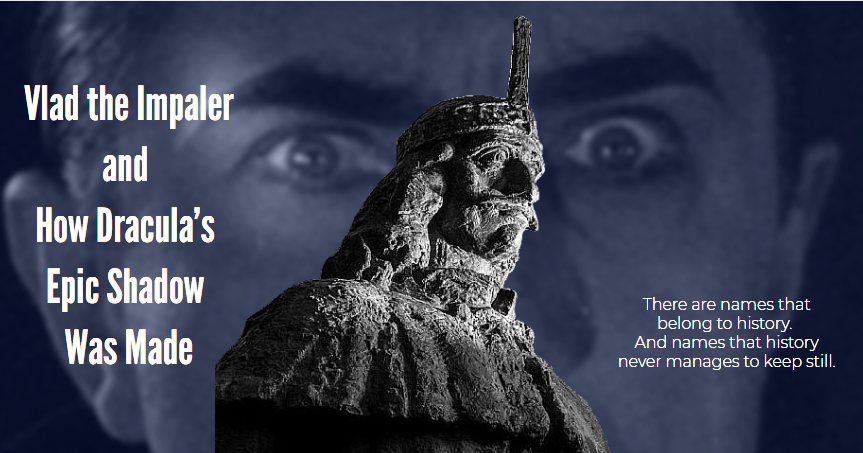
Long before Bram Stoker wrote Dracula there was Vlad the Impaler: voivode of Wallachia, enemy of the Ottomans, ruler feared as much for his punishments as for his political cunning.
This is the Vlad who moves through the pages of When Secrets Bloom and Kate’s Letter, included in the Courage Anthology out 17 JUNE. Vlad the man, consumed by passions and hidden fears—not as a figure of legend already swallowed by bats and myth. A man still anchored in the hard geography of his own century.
There are names that belong to history. And there are names that history never manages to keep still.
Dracula is one of them.
It does not sit quietly on the page like a date or a title. It moves. It shifts shape depending on who is speaking, who is remembering, and who is imagining. At times, it is a fifteenth-century Wallachian prince recorded in fragments of war and political rupture. At times it is a creature of Gothic invention, rising out of a coffin into the anxieties of Victorian Europe. And at other times it is neither man nor monster, but something stranger still: a name that refuses to stay buried.
Vlad Dracula was not immortal.
He bled, aged, fought, vanished into war and death like countless other medieval rulers. Yet unlike most princes of the fifteenth century, Vlad did not remain buried within the century that produced him. His name endured. It crossed borders. It slipped free of history and entered legend.
The defining shadow over Vlad’s youth was not myth, but his captivity.
After his father, Vlad II Dracul, lost his throne amid conflict with the Hungarian regent János Hunyadi, he sought Ottoman support from Sultan Murad II. Assistance came, but at a cost. As a guarantee of loyalty, Vlad and his younger brother Radu were sent to the Ottoman court as political hostages around 1444. Vlad III would have been round 13 years old. He lived at the sultans court until the age of 17.
The arrangement was not exceptional for the fifteenth century. Noble hostages were not treated as prisoners in chains, but as living guarantees of obedience. Within the Ottoman court, Vlad was educated and exposed to one of the most sophisticated and centralised systems of power in the medieval world.
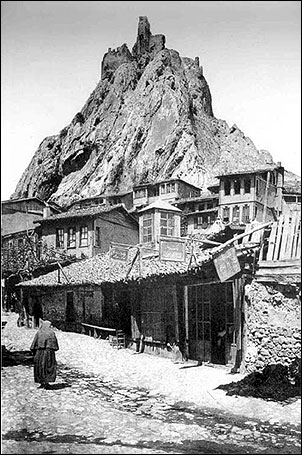
Yet that experience left an imprint that cannot be ignored. Not through torture, but through structure.
Wallachia’s politics were fragmented, dependent on unstable alliances between nobles whose loyalty shifted with circumstance. Authority had to be negotiated, constantly reinforced, constantly defended.
The Ottoman system, by contrast, appeared absolute. Power radiated from the centre. Command was direct. Failure was not debated: it was replaced. In that contrast lay a lesson Vlad would not forget.
When he returned to Wallachia and later seized power, traces of that system reappeared in his rule. Authority became centralised, obedience uncompromising. The boyars—noble families whose shifting loyalties had destabilised his homeland and destroyed his lineage (his father and older brother Mircea had just been ruthlessly killed) became the focus of his discipline. His brutality was not incidental. It was structural. Fear became governance.
When he too the power for a second time even his name carried weight shaped by conflict.
This same mentality shaped his warfare.
Vlad rarely possessed the numbers necessary to defeat the Ottoman Empire in open battle. Instead, he relied upon speed, surprise, reconnaissance, psychological warfare, and calculated brutality.
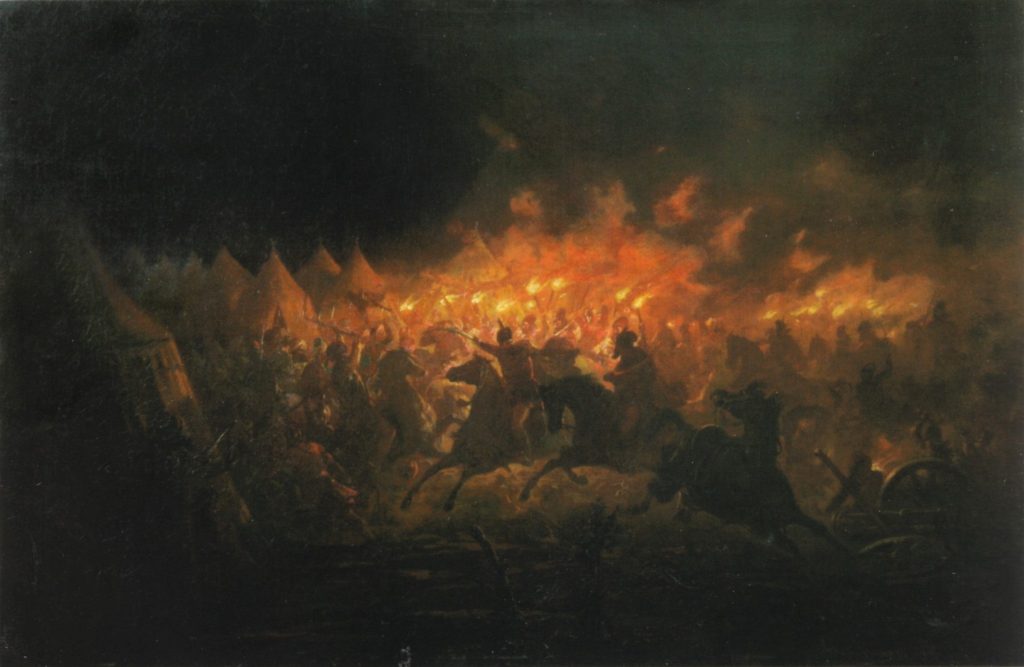
During the famous Night Attack at Târgoviște in 1462, he launched a daring assault directly into the camp of Mehmed II, disguising troops in Ottoman dress and attempting to strike at the Sultan himself under cover of darkness. Though the attack failed to kill Mehmed, it spread confusion and terror through the Ottoman camp and demonstrated Vlad’s preference for shock over conventional warfare.
Even the infamous “forest of the impaled” carried military purpose alongside horror. When Ottoman forces advanced into Wallachia, they reportedly encountered thousands of corpses mounted on stakes outside Târgoviște. The spectacle was designed not simply to punish enemies, but to break morale before battle even began.
In this, Vlad ruled as a prince of the violent early Renaissance world: ruthless, politically calculating, resourceful, and acutely aware that fear could become a weapon more powerful than armies.
Not the historical ruler at first. Not the vampire. Merely the name.
Dracula. From etymology to history
The name Dracula emerged from dynastic and political lineage. It derived from his father’s title “Dracul,” meaning “dragon,” linked to the Order of the Dragon founded by the Holy Roman Emperor Sigismund of Luxembourg in 1408 to defend Christendom against the advancing Ottoman Empire. Members wore the dragon as their symbol, and from this association Vlad’s father acquired the byname Dracul.
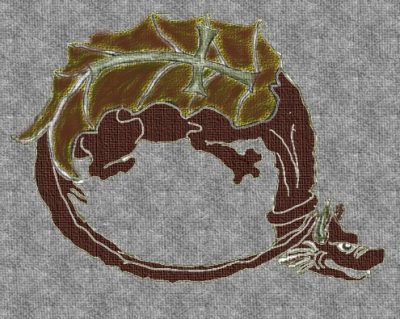
Thus “Dracula” meant “son of Dracul”—son of the Dragon. Yet in vernacular evolution, “dracul” also began to carry darker connotations, shifting toward “devil,” layering ambiguity into the very identity Vlad inherited.
It was a dynastic name, political rather than supernatural, inherited like a blade passed from father to son. Yet history darkened it quickly.
Vlad’s elder brother, Mircea, was captured and buried alive after being blinded with hot irons, while their father was murdered amid the chaos of Wallachian power struggles. Blood and betrayal marked the family long before legends ever did. By the time Vlad inherited the name Dracula, it already carried the weight of violence, vengeance, and survival.
But Vlad was still only a man.
It is in the aftermath of his rule that history begins to distort him.
The earliest German pamphlets circulating in the Holy Roman Empire portrayed Vlad the Impaler not as a political ruler, but as a figure of grotesque cruelty. Stories multiplied: vast forests of impaled bodies stretching outside city walls; banquets held in the presence of the dying; punishments so excessive they appeared to belong to nightmare rather than statecraft. Whether exaggerated for propaganda or rooted in fragments of truth, these accounts fixed Vlad in the Western imagination as something closer to monster than monarch.
Yet within Romanian historical memory, another Vlad endured. A harsh ruler, yes—but one shaped by a violent age, defending his territory against Ottoman expansion and internal fragmentation. In this tradition, his cruelty was not interpreted as sadism, but as severity in service of order, sovereignty, and survival.
Two portraits emerged from the same life.
One a tyrant. To much of Western Europe, Vlad became a butcher prince whose name inspired horror.
One a defender. To many Romanians, he became a symbol of strength, resistance, and national defiance.
Neither a vampire. That connection would come much later, imposed retrospectively by popular culture and the enormous shadow cast by Count Dracula.
And at this stage in history, he still belonged entirely to the world of men.
It is at this point that Vlad ceases to belong only to history. He begins to belong to narrative.
The historical Vlad the Impaler existed within the brutal logic of the fifteenth century, where violence was political language and survival often depended upon terror. Yet over time, the sheer brutality associated with his name created fertile ground for mythmaking. The stories darkened as they travelled. Cruelty became bloodlust. Bloodlust drifted toward the supernatural.
Bram Stoker published Dracula on May 26, 1897.
The transformation was nearly complete. Popular documentaries, novels, and sensational histories increasingly merged Vlad with the vampire Count until many assumed the two had always been one and the same.
Count Dracula emerged from the anxieties and imaginations of Victorian Gothic literature.
And like a vampire itself, the fictional Dracula fed upon what already existed.
Stoker borrowed a name discovered in historical research. Around that name he built something new: an aristocratic predator suspended between death and life, moving through moonlit corridors and decaying castles, carrying with him fears of corruption, invasion, sexuality, disease, and spiritual damnation.
The Count was never simply Vlad reborn. He was something stranger—a literary creature nourished by fragments of history, folklore, and Victorian dread.
The fictional vampire gradually eclipsed the historical prince.
Vlad’s name, once tied to Wallachian politics and Ottoman wars, became inseparable from coffins, bats, blood, and immortality.
The folkloric vampire entered Western literature through the convergence of two forces: eighteenth-century reports of alleged vampiric outbreaks in Eastern Europe, and the rise of Gothic literature.
The word “vampyre” entered English usage in the early 1730s, carried westward through reports of disturbances in Central and Eastern Europe. Entire communities reported corpses that seemed not to remain in the grave. So widespread were these accounts that officials, clergy, and scholars all became involved in attempts to explain them.
In 1746, the French Benedictine scholar Dom Augustin Calmet published influential writings on the subject, including accounts of the case of Arnold Paole, contributing to the intellectual fascination with the undead in Enlightenment Europe.
At the same time, European thought was shifting.
The Age of Reason began to fracture under Romanticism, which turned instead toward emotion, terror, imagination, and the sublime. Gothic literature emerged from this atmosphere: ruins, storms, castles, and graveyards forming its aesthetic language.
The vampire entered literature not as an immortal aristocrat, but as something older and more disturbing: a corpse that refuses to stay buried. In early literary forms, immortality is not yet central. The creature exists, but it does not reign.
In Lord Byron’s epic The Giaour, the vampire remains a cursed figure bound to blood and punishment. Byron’s lines describe not eternal life, but eternal torment:
““But first on earth, as Vampire sent,
Thy corpse shall from its tomb be rent;
Then ghastly haunt thy native place,
And suck the blood of all thy race;
There from thy daughter, sister, wife,
At midnight drain the stream of life;
Yet loathe the banquet, which perforce
Must feed thy livid, living corpse,
Thy victims, ere they yet expire,
Shall know the demon for their sire;
As cursing thee, thou cursing them,
Thy flowers are withered on the stem.”
Even here, the emphasis remains consistent: the vampire is not a being of infinite life, but a violation of death itself.
During the nineteenth century, the figure of the vampire becomes more refined, more psychological, more seductive. The Vampyre transforms the vampire into an aristocratic predator.
Yet even now, immortality remains secondary. The horror lies not in endless life, but in unnatural persistence.
It is in Bram Stoker’s Dracula that the vampire becomes fully conceptualised.
Here, Stoker introduces the term “Un-dead,” placing the creature in a liminal state: neither living nor fully erased. A body animated beyond death, performing life without belonging to it.
Abraham Van Helsing attempts to define this condition: “When they become such, there come with the change the curse of immortality; they cannot die but must go on age after age adding new victims and multiplying the evils of the world.”
“The vampire live on, and cannot die by mere passing of the time.”
Time alone cannot kill it—but human action can.
The so-called “curse of immortality” is therefore moral rather than literal. The vampire is described as “a foul thing for all eternity”, aligned with corruption and spiritual inversion rather than natural existence. Within Stoker’s framework, a sharp distinction emerges between the “Un-dead” and the “true dead”—one a state of damnation, the other of peace.
As in the scene surrounding Lucy’s destruction: “But the most blessed of all, when this now Un-dead be made to rest as true dead, then the soul of the poor lady whom we love shall again be free … [and] she shall take her place with the other angels”.
And after her staking: “No longer she is the devil’s Un-Dead. She is God’s true dead, whose soul is with him” (311).
Even Mina Harker imagines a final spiritual resolution: “Just think what will be his joy when he too is destroyed in his worser part that his better part may have spiritual immortality.”
This is where immortality truly enters the story.
Not in the supernatural sense. Not in endless biological existence. Neither Vlad nor Dracula embodies that cleanly. The folkloric vampire itself was never fully immortal; it could be destroyed by stake, blade, fire, or ritual. Even Stoker’s Count survives only so long as hunters fail to corner him.
From this point, the Count begins to escape his own novel.
But cultural immortality—that is another matter entirely. Vlad the Impaler achieved it through history transformed into legend. Count Dracula achieved it through fiction powerful enough to outlive its century.
One was a man who became myth. The other a myth that became more recognizable than the man himself.
And perhaps that is the most vampiric aspect of all: Dracula survives by feeding. Not on blood, but on memory. On reinvention. On every generation that resurrects him once more from the grave of the past.
Yet even this literary immortality is not the final transformation. The most persistent shadow of all belongs not to fiction alone, but to its collision with history.
One was a man absorbed by history. The other a name that history could never stop reinventing. Between them, Dracula was born—not as a creature of night, but as a shadow cast backward through time.
Yet chronologically, the order remains clear.
First Vlad.
Then legend.
Then folklore.
The Gothic imagination.
Bram Stoker.
The modern myth that refuses to separate them.
Between Vlad III Dracula, the mortal prince of Wallachia, and the immortal Count Dracula of fiction, Dracula is not a single figure at all.
He is a succession of shadows, each generation reshaping the last.
It is this uncertain space between history and shadow that I thought of while writing When Secrets Bloom and Kate’s Letter included in the Courage anthology OUT 17 JUNE. Rather than the immortal monster of modern imagination, the Vlad who lingers there is still human, haunted by the world that shaped him, by memory and loss. Long before Dracula became a creature of the night, there was a man who had dreams, but carried the burden of the name.
About the research:
Patricia Furstenberg is a Romanian-born historical fiction author whose Blood of Kings, Heart of Shadows series explores medieval Transylvania, Wallachia and Moldavia. Her research takes her into the history, folklore, landscapes and forgotten stories behind the fiction.
Many thanks for your work here, Patricia, in tracing the history of Vlad and his absorption from history into myth, legend and literature, this last through Stoker’s novel. I’ve been to Whitby and seen how the town has been influenced by this text – although I’ve never been to the Gothic festival which takes place there annually. The man – or the idea of him – has been immortalised in this way. I shall have to revisit my copy of this book, which contains several essays on its origin and influences, in which Vlad is a major figure. Wonderful work on your part.
With great pleasure, Laura. There’s so much to consider if you want to discern the man from the myth. And not easy because few primary resources were left from the time of VLad III Dracula, and almost non objective.
I haven’t visited Whitby, I’m glad you did. But I now how much the myth of Dracula influenced Transylvania and still is. I hear they will build a Dracula Land. Why not a museum with VR? I took part in an Europeana storytelling festival recently and a panelist from Slovenia demonstrated the use of VR,
holograms, and 3D modelling as well as touch technology – using special gloves to touch and feel the exhibits.
That sounds like a good idea Patricia; it just needs someone with money and influence to get behind it and make it happen. Who knows? If they’re talking about a Dracula Land it could be a valid part of that.