
The years Vlad III spent in Moldavia and Transylvania, exiled, perhaps at the Edirne Ottoman court too, are the ones we now the least about-almost no records were left. These are the years that sparked my imagination writing the historical fiction saga Blood of Kings, Heart of Shadows.
So what exactly do we know about the time Vlad III spent seeking refuge at the Ottoman court an then exiled at the Moldavia court and in Transylvania? He was not yet calling himself Vlad Dracula, and not yet called Vlad the Impaler either.
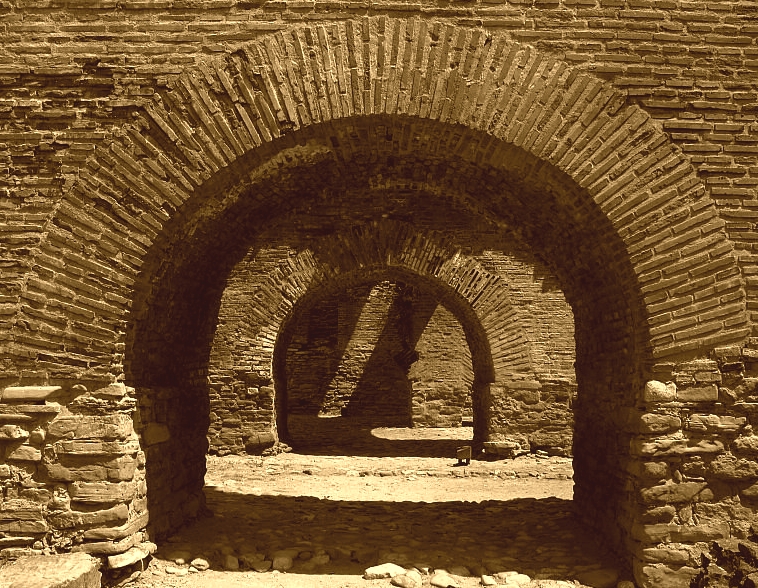
We saw how Vlad’s first reign ended almost as quickly as it had begun: when John Hunyadi returned from the disastrous campaign at Kosovo, he moved against the young voivode. By early 1449, Vladislav II had recovered the Wallachian throne (on January 5th, 1450, he was already signing letters at Targoviste) and the young prince from Draculesti clan was once again a fugitive.
Winter 1449, Vlad III travels from Targoviste to Edirne
Some historians believe that, initially, Vlad III turned towards Edirne, the Ottoman court where he had spent much of his youth as a hostage.
From Targoviste, Vlad would have followed the same route he took 12 years back, with his father: via Giurgiu Fortress, across Danube, through Bulgarian territory (then under Turish occupation), to Edirne.
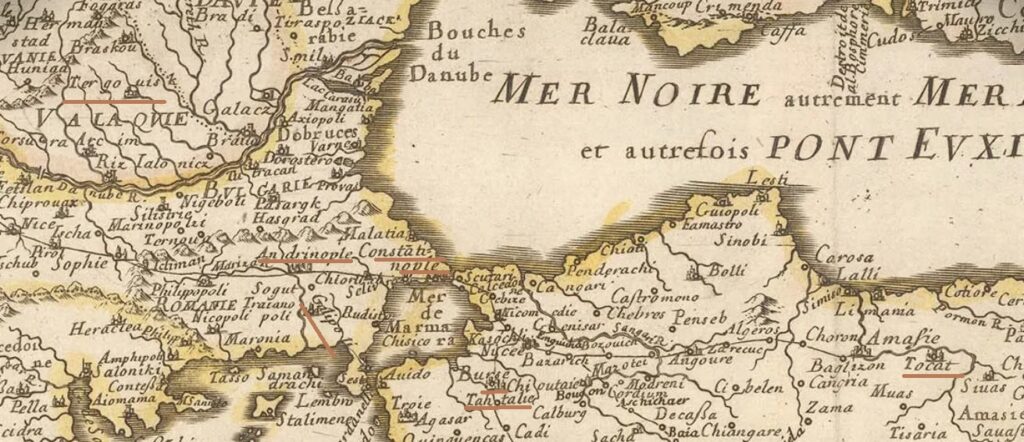
First named Uskudama by local tribes, the name was changed to Hadrianopolis in 125 CE by Emperor Hadrian, nicknamed Adrianople by the villagers, renamed Edirne same name, but in Turkish) in 1369 by Sultan Murad I.
It makes sense, Vlad III had just taken the throne with the aid of Sultan Murad II, a few months earlier.
But the political situation had changed. Vladislav II was cultivating his own relationship with the Ottomans. The Turks were far more threatening than the Hungarians; Wallachian voivodes feared the Sultan more, as the Sultan could mobilise a Turkish army with a single order, whereas in Hungary the excessive privileges granted lately to the nobles were already making themselves felt, so the Hungarian army was much slower to mobilise, with a presence that could be relied upon much less (as Vlad Dracula will later discover, especially during his third and last reign).
As a result of Vladislav II recent alliance with the Ottomans, Vlad III had little room to recover his throne through the court that had once supported him.
Some historians believe that Vlad III was id mortal danger at the court of Edirne
The lack of a reaction from the Ottoman power consolidates the idea of a newunderstanding with the new voivode of Walachia, Vladislav II. Chronicler Laonic Chalcocondil mentions that the new Walachian voievode has decided that – given the uncertain political situation – he should send emissaries to the sultan and should reconnect with the empire…

Vlad flees the Ottoman court
Vlad III therefore turned north, to Moldavia.
Why?
Vlad’s choice to turn to Moldavia, a state engaged in the anti-Ottoman fight, tells us that his life must have been seriously endangered. The new Wallachian voivode, Vladislav II, certainly desired to get rid of this young candidate from the opposing house, who had already occupied the throne (just before him) and had benefited of the Ottoman favours in the recent past. His plans of killing Vlad are perfectly explicable in the spirit of the times.
In this context, the issue of an eventual assassination is possible. The new Wallachian voivode Vladislav II’s desire to get rid of the young candidate who had already occupied the throne before him and had benefited of the imperial favours is perfectly explicable in the spirit of the times.
So, the presence of Vlad III in the lands ruled by the Ottoman power was becoming impossible.
Which route would have Vlad III followed between Edirne and Roman Fortress, Moldavia?
If he was fleeing for his life I believe he would have avoided major Ottoman points and much of Wallachia… He might have crossed Danube at Silistra, a large city at that time and situated in the Rumelia Province to which Edirne was the capital.
Rumela Province was overseen by Dayı Karacabey. He was a prominent military commander and high-ranking official under Murad II. As such, when Vlad III and his younger brother Radu were held as political hostages at the Ottoman court during the 1440s, they would have encountered the Bey.
After crossing Danube at Silistra Vlad would have rode north, bypassing the snowy Carpathian Mountains and Transylvania where John Hunyadi (who had just ordered the killing of his father) was governor. He would have soon reached safety, the Moldavian territory.
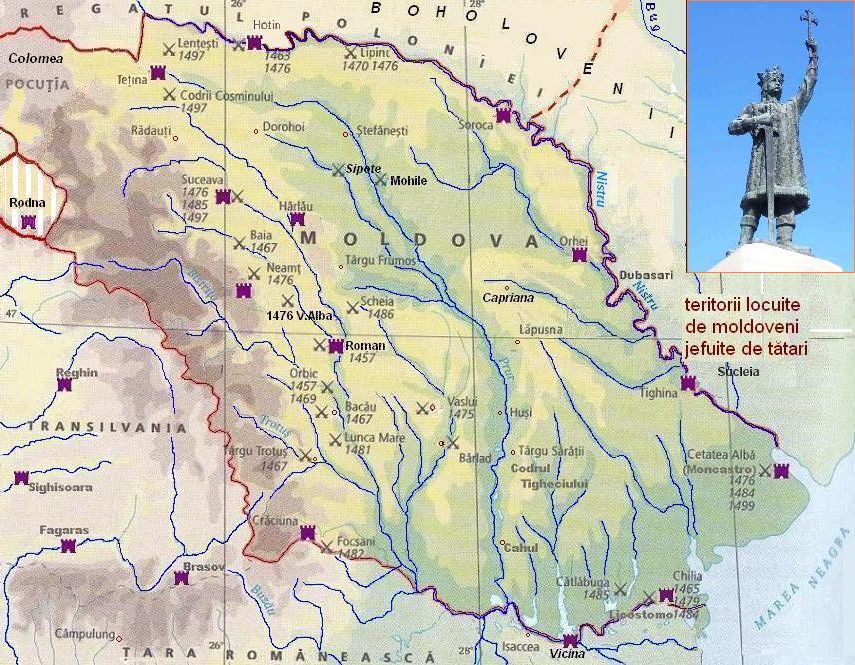
Vlad III at the Moldavian court, 1449-1451
By December 1449 Vlad had reached Moldavia where his maternal uncle, Bogdan II, offered him refuge. The family connection was significant: Bogdan himself had once found shelter at the court of Vlad’s father, Vlad Dracul. Now the positions were reversed, with the young Wallachian exile dependent upon Moldavian protection.
The surviving evidence for Vlad’s years in Moldavia is sparse, and the precise sequence of events remains uncertain. What is clear is that he stayed in the region during a period of violent political change and came into contact with another young prince whose future would become closely linked to his own: Stephen (soon to be remembered as Stephen the Great, Stefan cel Mare), the son of Bogdan II and future ruler of Moldavia. Later tradition describes a close relationship between the two, although the surviving evidence does not allow us to establish its precise nature.
Bogdan’s wife and Stephen’s mother was Lady Maria Oltea, a Wallachian princess.
It was a great pleasure to include Lady Oltea in my novella The Book That Should Have Been Lost and in Book 3 of my saga, Blood of Kings, Heart of Shadows.

At the Moldavian court: young Vlad Dracula and young Stephen the Great, cousins
In 1449-1450, Vlad and Stephen were both young, both stubborn, and both born into a world where princes were expected to fight. They were two young wolves learning the boundaries of their territories even as those boundaries shifted beneath their feet.
Vlad was eighteen or nineteen; Stephen was barely twelve, yet both had already been drawn into the brutal education of princely life.
Moldavia was far from peace. The Polish Empire wished to set one of their own on its throne, to gain exit at the Black Sea. During the first part of his reign, Bogdan II established his throne at the old Roman fortress.
Moldova 1450: Vlad III at Crasna Battle
Vlad III and Stephen took part in the Crasna war alongside Bogdan II (the Moldvian-Polish war lasted January-September 1450, the decisive battle taking place between 5-6 September 1450.
Perhaps Vlad and Stephen would have grown into their roles amid the same violence and uncertainty, learning from the same world of ambushes, alliances, betrayals, and shifting loyalties. Vlad, wickedly helpful in the way only Vlad could be, might have spared his younger companion a few hard lessons—or invented a few of his own. Perhaps Stephen looked up to him. Perhaps he stubbornly refused to for a boy destined to rule his own country might already have carried a formidable will of his own. Either way, two future rulers were already watching, learning, and measuring each other long before history gave them their crowns.
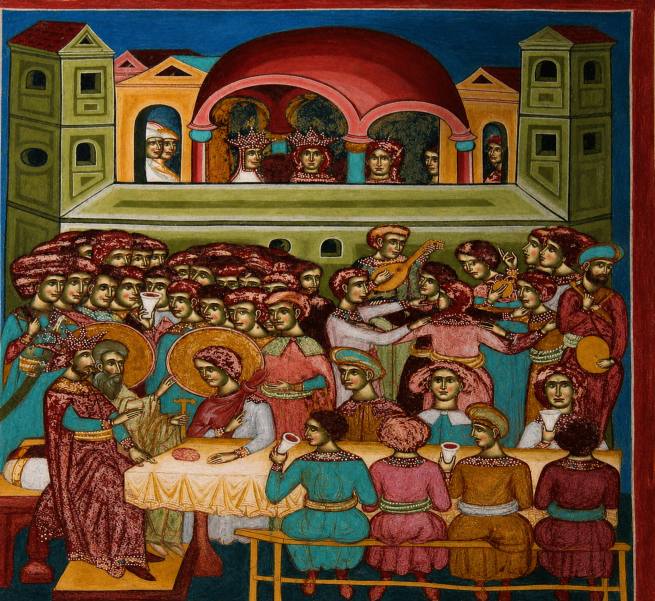
Vlad Dracul and Stephen the Great: their many blood connections
Vlad and Stephen were cousins.
Vlad’s mother, Eupraxia of Moldavia, was the daughter of Prince Alexander I of Moldavia (Alexander the Good) and sister of Bogdan II, Stephen’s father.
The last wife and greatest love of Stephen the Great was Maria Voichița of Wallachia (25 years her junior), the daughter of Radu the Handsome – Vlad Dracula’s younger brother. Initially Maria Voichița and her mother, Lady Despina, were Stephen’s war prisoners in care of his second wife, Maria of Mangop.
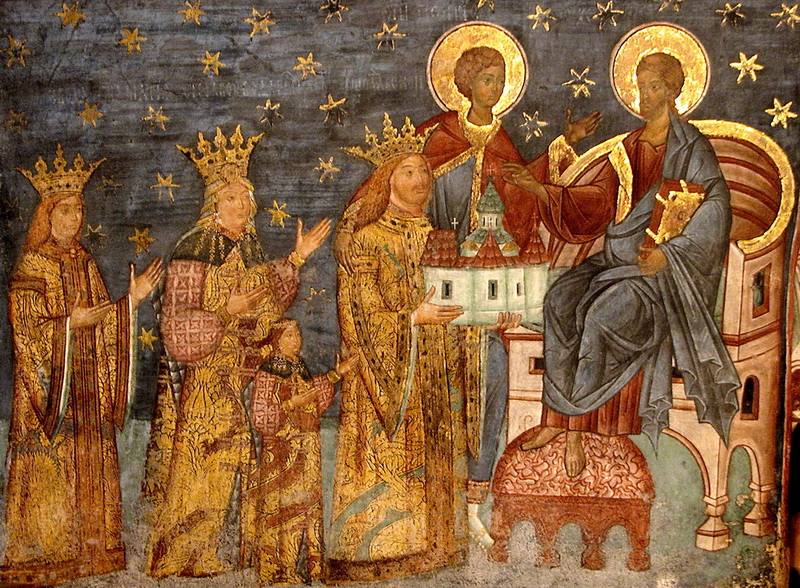
Vlad III at the Old Roman Fortress in Moldvia
The Old Fortress of Roman, also known as the Mușatin Fortress, was the city’s first fortress, built in the late 14th century—probably under Petru I Mușat (1375–1391), towards the end of his reign. It was situated on the high plateau above the left bank of the Moldova River.
The mother of Vlad III, Eupraxia of Moldavia, was the grand-grand daughter of the first ruler of Moldavia, Bogdan I, ounder of Muşatin family.
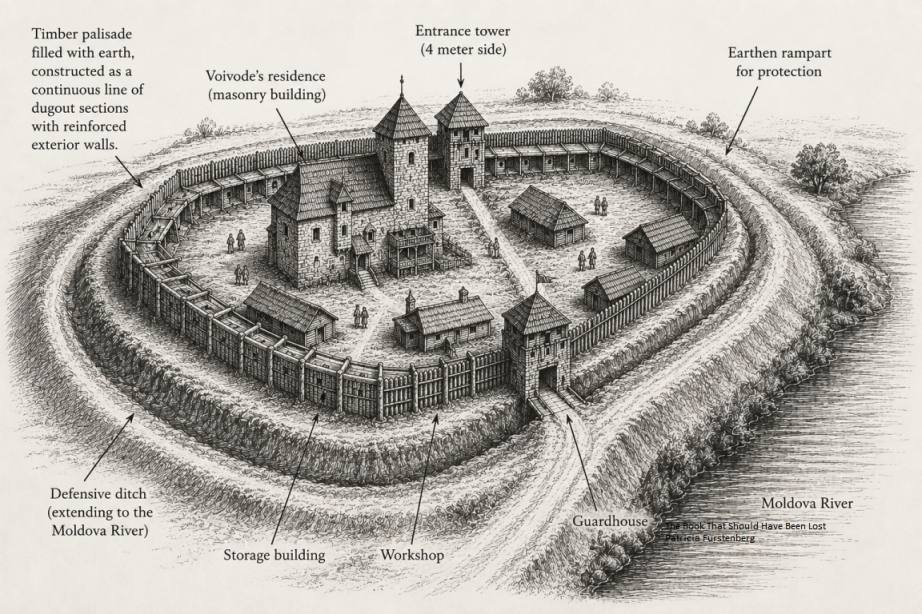
Archaeological research has revealed that the Old Roman Fortress was built using a palisade design consisting of timber beams packed with earth. The palisade was formed by an unbroken chain of semi-sunken dwellings with reinforced outer walls, thereby enabling the defenders sheltered within them to remain constantly at their posts. This palisade was protected on the outside by an earthen rampart and a defensive ditch that extended as far as the Moldova River. Access to the citadel was gained through a tower with a four-meter side length, located on the northern side of the stronghold.
Old Roman Fortress would have looked something like this:
For Vlad III in Moldavia life would have meant more than refuge. The court of Bogdan II and Lady Oltea gave him the experience of another political world, one increasingly connected to the Hungarian sphere and opposed to unchecked Ottoman expansion. He was learning, through necessity, how a dispossessed prince could survive by moving between courts and cultivating alliances.
It was during this time that young Vlad Dracula spent at the Moldavian court that I placed two of my novels, The Book That Should Have Been Lost (out now) and Book 3 of the Blood of Kings, Heart of Shadows saga.

The peaceful time enjoyed by Vlad III in Moldavia ended on the early hours of October 1451, when Bogdan II was murdered. It happened in the village of Răuseni, at a wedding.
Vlad’s wandering continued.
His next destination would bring him into the orbit of János Hunyadi—the Hungarian commander whose intervention had once helped drive Vlad’s family from power, but who would now become one of the most important figures in Vlad’s struggle to regain the Wallachian throne.
Fleeing from Moldavia to Transylvania, October 1451
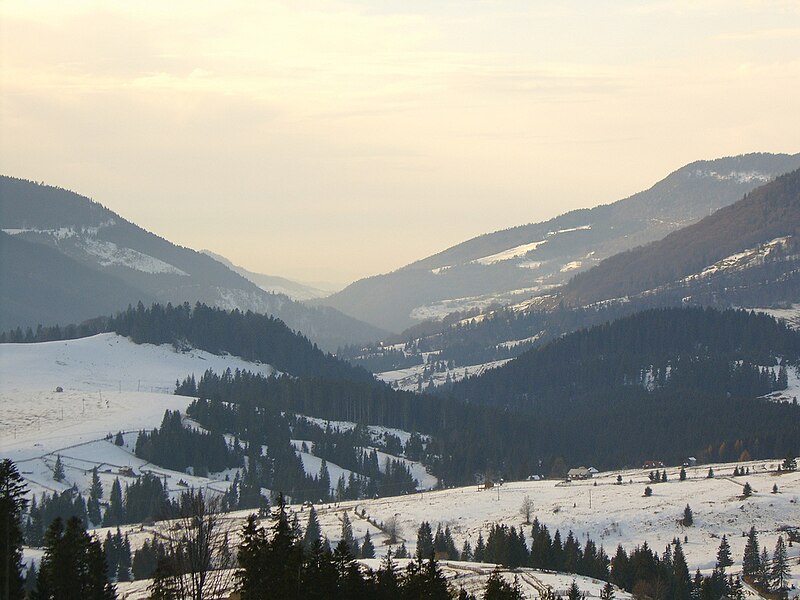
The murder of Bogdan II on the early hours of 16 October 1451 changed Vlad’s situation overnight. His protector was dead and the new ruler, Peter Aaron (who previously supported Vladislav II to climb on the Wallachian throne forcing Vlad to flee), had little reason to tolerate the presence of the young Wallachian claimant.
Vlad fled Moldavia and, according to one reconstruction, he travelled with Bogdan’s son, the young Ștefan, future Stephen the Great.
Vlad at Borgo Pass, Pasul Tihuța, autumn 1451
Their route may have taken them through the Borgo Pass (officially known as Pasul Tihuța) into southern Transylvania—a dramatic crossing from the Moldavian highlands into the Hungarian sphere.
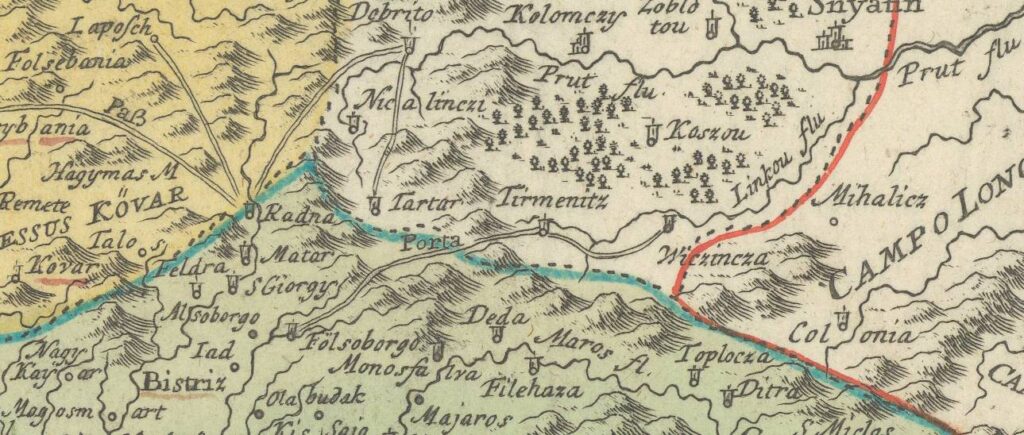
After all, the governor of Transylvania, John Hunyadi, was an ally of Bogdan II.
1451, Vlad III returns to Transylvania after 15 years
It’s been about 15 years since Vlad Dracul had left Sighisoara to climb on the throne of his father, the Wallachian throne. Fifteen years since Vlad III had last set foot in Transylvania – as long as remaining records tell us…
This time, Transylvania was not simply a refuge. Vlad III wanted the throne of Wallachia back.
Vlad’s whereabouts during this time in Transylvania, 1451-1452, are little documented. It is known that he moved between the castle of the Hunyadi, Kronstadt (Brasov), and Hermannstadt (Sibiu).
Vlad at Hunyadi Castle
During the winter of 1451–1452, Vlad was associated with Hunyadi Castle, the great fortress of the Hunyadi family.
Approaching it, a visitor would have crossed a narrow bridge over the moat before entering a stronghold of towers, walls and defensive works. Yet for Vlad, its greatest importance was not its stone.
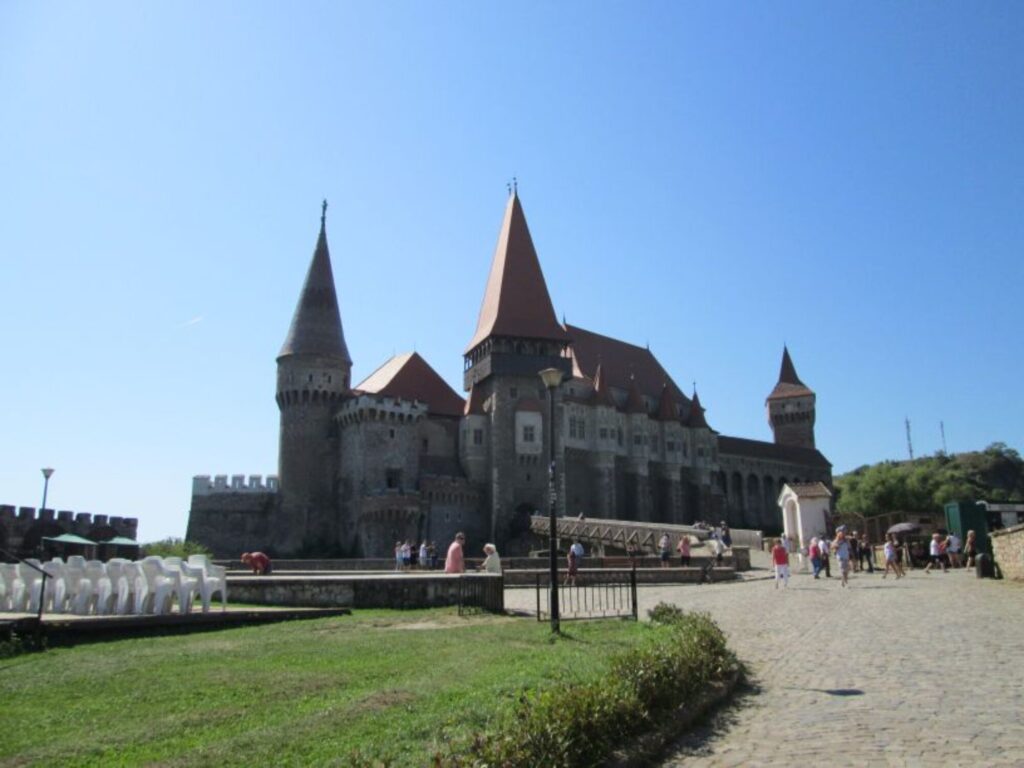
It was the man who commanded it.
Vlad had every reason to hate Hunyadi. The Hungarian commander had been involved in the political struggle that had brought about his father’s downfall. Yet Hunyadi was precisely the man Vlad now needed. The young exile could not reclaim Wallachia by himself.
So, if he wanted a future, he had to set vengeance aside.
The enemy of my enemy could become my ally.
John Hunyadi was among the wealthiest and most powerful lords in the Kingdom of Hungary, with an extraordinary landed estate: around 27 castles, 52 towns, and more than 1,000 villages. Such vast holdings brought him not only immense wealth but also the means to maintain a personal army, ready to fight at any moment, giving him considerable military and political power in an age when a lord’s influence depended as much on the men he could summon as on the lands he controlled.
Vlad III in Kronstadt / Corona / Brașov – February 1452
By February 1452, Vlad III was near Brașov (Kronstadt), gathering support for another attempt against Vladislav II who ruled Wallachia.
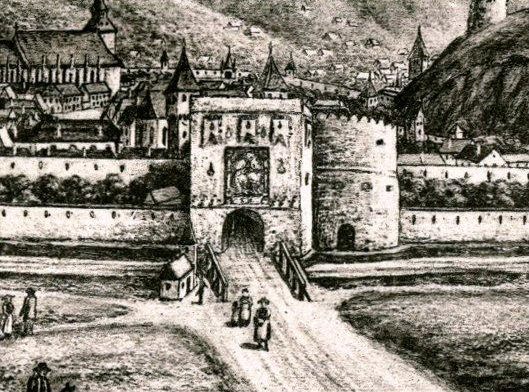
Being in Transylvania and acting as a claimant to acquire the throne of Wallachia, Vlad III would have placed the Hungarian Kingdom in a delicate position. Also, John Jumyadi was seriously endangering the good enacting of the Turkish-Hungarian treaty by not getting involved in such an action.
Therefore, a letter from John Hunyadi to the people of Brașov, dated 6 February / 30 March 1452, ordered them to send Vlad, “Illustris princeps Wlad filius quondam Drakwl Waywode” back to Moldavia and “give him no military support,” because he was preparing to move against Vladislav without Hunyadi’s permission (he’d just signed a three years peace with the Ottomans that also recognized Vladislav II as ruler of Wallachia) – but to protect him, meaning allow him passage.
The order reveals how far Vlad had already moved beyond the role of fugitive. He was actively seeking men and resources for another return to Wallachia.
Alone in Transylvania, how could Vlad III hope to succeed?
The evidence does not tell us. One possibility is that he had retained the loyalty of Wallachian boyars who had supported him during his first reign. Another is that he attempted to raise an army around Brașov using his own resources, or perhaps by borrowing money from wealthy townsmen.
Geoagiu, near Hermannstadt / Sibiu – Vlad’s life was always in danger
At some time during his stay in Transylvania Vlad went west, towards Sibiu, but even there he was not safe.
The authorities were warned of his presence, and Nicolae de Ocna, the city’s vice-governor, acted on Hunyadi’s instructions. Vlad never made it to Sibiu. An ambush was prepared at Geoagiu. Two Transylvanian nobles, Gereb de Wingart and Nicolaus de Vizacna, were said to have attacked Vlad there with the intention of killing him, acting “out of love for Vladislav.”
We know this from a letter dated 14 March 1457, written by Vlad to the heads of Hermannstadt and reminding them of the incident on his life “back when he was a wanderer and walked among them.“
We do not know exactly how the encounter unfolded, but we can imagine (I now I do!) We know only that Vlad survived. And survival had become something of a habit.
Once again, the young Wallachian claimant slipped away, leaving behind a trail of uncertain destinations. Wherever Vlad went next, one thing was becoming clear: he had spent years travelling because the land he was meant to rule was given away, as it pleased the great powers of his time: Hungarian Kingdom and Ottoman Empire.
Soon, his travels would teach him when—and how—to return to rule Wallachia.
Vlad was back in Moldavia by the end of March 1452
Hunyadi intervened and, by 30 March 1452, another letter from Hunyadi to Brașov confirms that Vlad had returned to Moldavia.
But it wasn’t as simple as it seems. Hunyadi had other political reasons for sending Vlad III back to Moldavia.
For Vlad, these first months in Transylvania were another lesson in the brutal logic of medieval power. A throne could be taken with an army, but keeping it required something more elusive: allies, money, timing—and the consent, or at least the tolerance, of the great powers surrounding Wallachia.
In 1452, Vlad Dracula had none of these in sufficient measure.
Not yet.
Why was Hunyadi against Vlad’s return to the throne of Wallachia?
It was all about the evolution of the relations among the great powers of the area: the Hungarians and the Ottomans. The conclusion of the treaty from Adrianople, November 20, 1451, between the Ottoman Empire and Hungary, built a new barrier for Vlad III, consolidating the position of the present Walachian ruler Vladislav II.
When Mehmed II returned to power, in February 1451, Vladislav II sent rich gifts to the sultan promising to also pay tribute, while at the same time preserving the relations with Hungary. Thanks to these agile politics (that were not really the Draculeti’s strong suit), Vladislav II of Walachia obtained a three year armistice.
The Ottomans were happy. The Hungarians were happy too – Hunyadi’s power was diminishing by now while the other strong Hungarian families (the Cilli and the Garai) pressured him to end his wars that were costing them too much.

Vlad returns to Transylvania, summer 1452: Brașov and Sibiu
By the end of summer 1452, Vlad found the political landscape increasingly favourable. Relations between Hunyadi and Vladislav II were deteriorating, while disputes over the new monetary reforms and territories such as Amlaș and Făgăraș (traditionally held by the rulers of Wallachia) deepened the conflict.
Vladislav II complaint to Brașov on 24 September that the town was sheltering his enemies. This shows how unsettled the region had become. Whether those enemies were directly connected with Vlad is uncertain, but the young claimant was now operating within a Transylvanian political network increasingly hostile to the Wallachian ruler.
In October 1452, Hunyadi ordered the people of Brașov to accept neither the Turkish nor the new Wallachian coin.
Vlad was under Hunyadi’s protection again.
The irony was considerable. Hunyadi had helped destroy Vlad’s father’s rule and had driven Vlad from his first throne. Now the same Hungarian commander saw the young exile as a possible replacement for Vladislav II.
After years of movement—from Wallachia to the Ottoman world, from there to Moldavia, and finally across the Carpathians into Transylvania—Vlad had reached the time and the place from which his next attempt at power would be launched.
The fugitive prince was no longer wandering without direction. He had found a patron and with Hunyadi behind him, the road back to Wallachia was beginning to open.
Vlad’s movements through Transylvania held purpose. Every town he entered had to be weighed for its usefulness: refuge, allies, money—or a road back to Wallachia.
Brașov was important because of its proximity to Wallachia and its connections with the Wallachian boyars who opposed Vladislav II. But Vlad needed more than sympathetic exiles. He needed an army. And, for that, he needed a powerful patron.
It could only be John Hunyadi.
During the years wandering between the Ottoman world, Moldavia and Transylvania, Vlad had learned that survival depended upon knowing when to abandon one court and seek another. This time he had found a place within Hunyadi’s political and military network.
Vlad entered Hunyadi’s service and received a military appointment, gaining close access to a commander who had spent decades fighting the Ottomans.
Near Hunyadi, Vlad could observe how campaigns were organised, how fortresses were defended and how military power depended upon political alliances as much as weapons.
Vlad III learned that a smaller force could make a larger army bleed without ever meeting it head-on. Studying John Hunyadi’s wars, Vlad saw how scorched-earth tactics, sudden night raids, ambushes, and intimate knowledge of the terrain could turn the enemy’s own strength against them. Hunyadi’s campaigns against the Ottomans taught Vlad the value of speed, surprise, and psychological warfare: strike where least expected, vanish before the enemy could regroup, and leave fear behind in the darkness.
Hunyadi also brought him closer to the Hungarian court. Vlad was presented to King Ladislas Posthumus, King of Hungary and Bohemia, at Győr, to whom Vlad Dracula swore allegiance, and was also present at the ceremonies marking the young king’s coming of age in 1453.
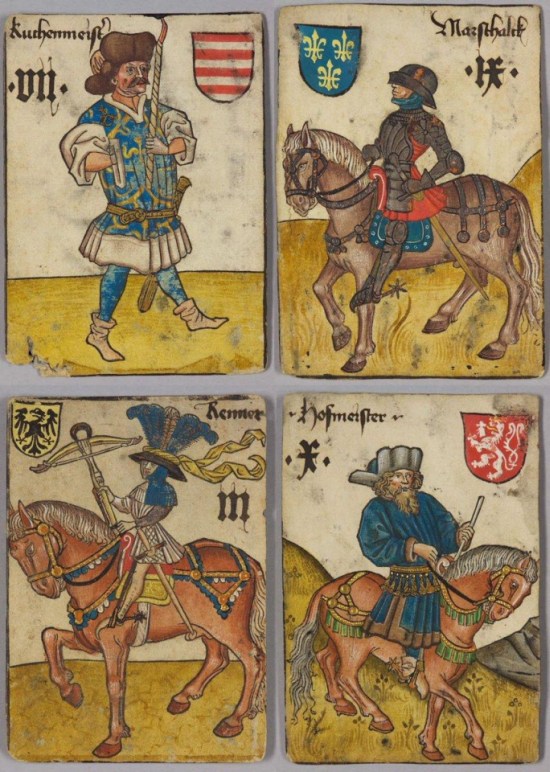
For a prince who had spent years in exile, these appearances mattered: he was once again being introduced to the political world in which his claim to Wallachia might be restored.
Vlad’s position strengthened further when he was entrusted with responsibility for the defence of Transylvania’s southern frontier against the Ottomans.
On 29 May 1453 the Constantinople fell. The old Byzantine world had vanished, and a new Ottoman power was emerging under the young Sultan Mehmed II.
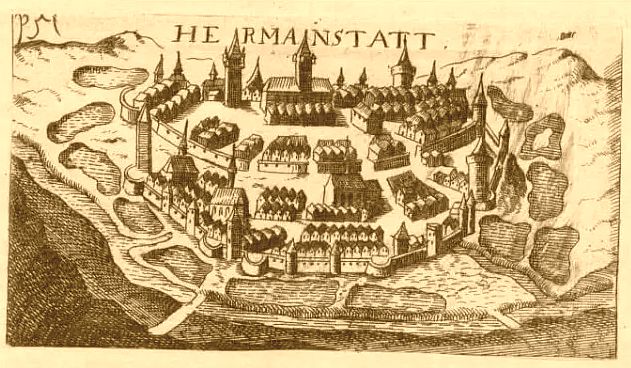
Vlad’s movements subsequently brought him to Sibiu, where he could remain within Hunyadi’s sphere of influence. His presence there placed him close to the Hungarian military and political network, even if it also bound him to Hunyadi’s interests.
For a young prince desperate to recover his inheritance, such protection was both refuge and restraint. Vlad stood on the opposite side of the frontier from the world he had known as an Ottoman hostage. He had lived among the Turks, learned their language and customs, and witnessed their military power from within. Now he was preparing to face them as a soldier of the Hungarian frontier.
The journey had taken him from Wallachia to Ottoman captivity, from Ottoman lands to Târgoviște, from exile in Moldavia to Transylvania—and finally into Hunyadi’s service.
He had not yet reclaimed Wallachia. But he was no longer trying to survive. He was preparing to return.
It was 1456. Time for Vlad to return to Wallachia as its right ruler.
How far did Vlad traveled 1449-1456:
Edirne – Silistra – Roman Fortress: 700km
Roman Fortress – Suceava Fortress: 100km
Suceava – Crasna Battle (and return): 200km x 2
Roman – Borgo Pass (Pasul Tihuța) – Transylvania (Kronstadt) (winter 1451-1452): 500km
Kronstadt – Suceava (spring-summer 1452 and return): 300km x 2
Kronstadt (Brasov) – Hermannstadt (Sibiu): 140km
On October 1st we will discover Where Did Vlad Dracula Live as Voivode of Wallachia during his second (but not last) reign: 1456-1462.
About the research:
Patricia Furstenberg is a Romanian-born historical fiction author whose Blood of Kings, Heart of Shadows series explores medieval Transylvania, Wallachia and Moldavia. Her research takes her into the history, folklore, landscapes and forgotten stories behind the fiction.
Such a short time to be filled with so many major events! The shifting alliances seemed to be constantly on the move, but I can see that his experiences must have taught him, however briefly, both military and diplomatic skills. I found this fascinating.
Hugs, Trish. I so appreciate you visiting here today 🙂 Yes! A roller-coaster of a life, I try to imagine how he must have felt, pushed around like this and having to hold his own. A different kind of life and the diplomatic and military skills he still picked up from everywhere are astounding.
This is such a fascinating story, and I’m learning so much about this particular period in history. I guess one day I’ll figure out how Bram Stoker came up with the story of Dracula. I know the story is fiction, but I’m really looking forward to reading more about what actually happened in this area, especially from a military perspective.
Thank you! And yes, Bram Stoker’s Dracula is a fascinating rabbit hole in itself. The novel is fiction, but the historical Vlad III and the turbulent world he inhabited provide a very different—and equally compelling—story. The military side is particularly revealing: shifting alliances, sieges, border warfare, Ottoman pressure and the constant Hungarian (and Pilish) struggle for power… all shaped this part of Europe. Even the Genoa and Venice… I’ll be exploring more of that as the series continues. 🙂
You’re welcome, Patricia. Every time I watch the movie, I keep looking at the non-vampire side of the story, and it’s fascinating. I’m glad you’re going to explore the power struggle in the series. I’m looking forward to it.
Head-spinning history, Patricia! Amazing how he got through to claim a prominent place in it. An incredible life. Thanks for sharing, Patricia.
Thank you, Laura 🙂 It really is a fascinating—and frustrating—period of Vlad’s life. Those missing years leave so many gaps that we have to piece together the fragments carefully. Exile, shifting alliances, and the struggle for power shaped the man who would later become so notorious. Sometimes, what history doesn’t tell us is almost as intriguing as what it does. 😉
Agreed, Patricia. It’s must be so frustrating but also deeply satisfying when some pieces click together. Good luck with your ongoing research.