
Vlad Dracula is one of history’s most enduring names. Known variously as Vlad III, Vlad Țepeș and Vlad the Impaler, the fifteenth-century ruler of Wallachia has travelled through the centuries in many forms: prince, warrior, political survivor, feared enemy of the Ottoman Empire, subject of stories and pamphlets, and eventually the historical shadow behind Bram Stoker’s Dracula.
But who was the man remembered as Vlad Dracula in documents or literature, and as Vlad the Impaler by his enemies? Where did he live? What happened to him as a boy? Why was he held by the Ottomans? What was his relationship with Matthias Corvinus? Where did the name Dracula come from? And how did a fifteenth-century Wallachian prince become one of the most recognisable figures in modern popular culture?
The historical Vlad was not a vampire, nor was his life confined to the legends that later grew around his name.
Vlad was born into a turbulent world of Wallachian princes, Ottoman expansion, Hungarian power struggles and rival noble families. His childhood took him away from home and into Ottoman captivity. He returned to a country divided by political rivalries, fought repeatedly for his throne, ruled from places such as Târgoviște and Bucharest, corresponded with neighbouring powers, and left behind documents that allow us to glimpse the man beneath the legend.
This page follows Vlad Dracula through his family, childhood, captivity, reigns, battles, places, letters and historical reputation—and explores how the real Vlad Țepeș eventually became inseparable from the Dracula legend.
Vlad Dracula: The Historical Man Behind the Legend
From Sighișoara to Târgoviște, from Ottoman captivity to the throne of Wallachia, this is the most truthful story of the historical Vlad Dracula—and the places, documents and legends that have preserved his shadow.
Who Was Vlad Dracula?
Vlad III, Vlad Dracula, or Vlad the Impaler? Vlad Țepeș in Romanian and Kazıklı Voyvoda (Impaler Prince) in Turkish?
We know from letters that his father, Vlad II, called him Vladul (Vlad-ul meaning The Vlad).
Vlad III did not originally call himself Dracula. The name came from his father, Vlad Dracul, whose title was associated with the Order of the Dragon. Vlad later adopted the patronymic Drăculea—“son of Dracul”—and by 1475 was signing documents as Wladislaus Dragwlya.
Impaler, Țepeș, was a name given to him later, because of his supposed preference for impaling. In contemporary sources, both foreign and domestic, he is never called by this name. It was not until 1508 that we find him referred to as Țepeș in an external document and again in 1550 as “Vlad voevod Țepeș.”
The Ottoman form Kazıklı Voyvoda (Impaling Voivode / Impaler Prince) appears in Ottoman sources only at the beginning of the 16th century.
Read on my blog:
Vlad the Impaler and How Dracula’s Epic Shadow Was Made
From Vlad Dracul to Dracula – from Vlad II to Vlad III
Vlad Dracul and the Order of the Dragon
In 1444 the Vovode of Wallachia was Vlad II, known as Vlad Dracul, who was Vlad the Impaler’s (Vlad Dracula’s) father.
Vlad II received his nickname Dracul being a member of the elite Order of the Dragon, fraternatis draconem, since 1431 (the year when his son Vlad III was born). The military Order of the Dragon was created in 1408 by Holy Roman Emperor Sigismund of Luxembourg to defend the cross and fight the enemies of Christianity, particularly the Ottoman Empire.
The membership of the Dragon Order was passed on from father to son, thus young Vlad III was also a member of the Order of the Dragon.
Thus, Vlad II was known as Vlad Dracul, or Drăculea (in Romanian),while his sons, especially Vlad III, Vlad the Impaler, was known as Son of Dracul, Dracul-a, Dracula.
(Spoken in Romanian, dragon or dracul can sound quite similar).
(Vlad’s elder bother, Mircea, was killed at the same time with their father, thus the membership of the Order was passed on to young Vlad III. Vlad III had two more brother who outlived him, Radu the Handsome and Vlad the Monk).
Below, we can see the symbol of the order and a medallion that Vlad II carried and was among the few relics he left to Vlad III, was a coiled dragon with a cross on top:
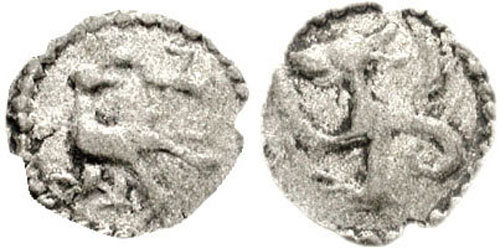
In Romanian folklore a dragon is the symbol of evil, even of the devil (dracul in Romanian) that always had to be defeated.
The Byzantines called Vlad II Dragulios or Dracules after he was invested with the Order of the Dragon.
Sighisoara and the coins minted by Vlad Dracul
Vlad Dracul held the right to strike coin, a privilege that reflected his authority as voivode. His son, Vlad III, is traditionally said to have been born in Sighișoara — but… was Vlad Dracula really born there?
The Order of the Dragon and Vlad Dracul: How Dracula Got His Name
Dracula. From etymology to history
The Family Behind Vlad Dracula
Mircea the Elder, Vlad Dracul and Vlad III
Vlad’s family history, from Mircea the Elder to Vlad Dracul:
Mircea the Elder and Vlad the Impaler, Family and Historical Ties
A Prince Born into Political Turmoil
The World Around Young Vlad III
The Dănești/Drăculești rivalry and the Wallachian succession – coming soon.
Young Vlad III: Childhood, Captivity and Return
Where Did Vlad the Impaler Live?
Join me in discovering al the fortresses and lands where Vlad Dracula lived during his early years.
Read more on my blog about Vlad’s years as an Ottoman captive.
Vlad was not even 18 years old. Discover Vlad’s return to Târgoviște and his first attempt to reclaim the throne
(more coming soon)
Vlad Dracula and the Throne of Wallachia
Târgoviște: Vlad’s First Royal Centre
Târgoviște, a Royal Palace in History
The Lonely Return of Vlad III to Târgoviște, Reclaiming the Wanted Throne 1448, Part 3
Following Vlad III in Moldavia and Transylvania: Exile and New Alliances, 1449–1456, Part 4
Vlad’s Second Reign
After his brief first reign in 1448, Vlad only returned to Târgoviște in 1456:
Where Did Vlad Dracula Live as Voivode of Wallachia, 1456-1462 (coming soon)
Bucharest, Vlad’s Second Royal Palace:
Vlad Tepes, Bucharest, and a Medieval Curse out of Context
Vlad and the Wallachian Boyars
coming soon…
Vlad Dracula and the Ottoman Empire
From Ottoman Captive to Ottoman Enemy
Vlad’s experience at the Ottoman court: Young Vlad: Captive in the Ottoman World – Where He Lived
The Night Attack at Târgoviște
Vlad Dracula, Hungary and Matthias Corvinus
Vlad Dracula’s struggle for Wallachia cannot be understood without looking north, toward the Kingdom of Hungary and its powerful king, Matthias Corvinus. During the fifteenth century, Wallachia stood between two formidable powers: the Ottoman Empire to the south and the Kingdom of Hungary to the north. For a prince determined to keep his throne, survival depended not only on armies and fortresses, but on choosing allies carefully—and knowing when those alliances might change.
Vlad and Matthias Corvinus
When Vlad III returned to power in Wallachia in 1456, his position was closely connected to Hungarian interests. especially Matthias Corvinus who was crowned King of Hungary in 1464 and who regarded the Ottoman advance as a grave threat to his kingdom – or an opportunistic ally. A strong ruler in Wallachia could therefore serve as an important barrier against Ottoman expansion – as long as that ruler followed the Hungarian political policy.
Vlad, too, needed Hungarian support. His position on the Wallachian throne was never secure, between the local boyars siding with the opposing Danesti blood-line and the Ottoman Empire that continued to exert enormous pressure on the principality. Vlas’s struggle was therefore part of a much larger contest in which Wallachia became a frontier between competing powers.
The relationship between Vlad and Matthias, however, was never simple. Political necessity could bring them together, while the shifting circumstances of war could just as quickly place them on uncertain ground.
Vlad Dracula and Matthias Corvinus: Prisoner, Ally and Political Pawn – coming soon
The Crisis of 1462
The relationship reached a dramatic turning point during Vlad’s confrontation with Sultan Mehmed II in 1462.
For two years Vlad had refused to accept Ottoman demands for tribute and launched [without Hungarian support] counter-attacks against Ottoman troops advancig along the Danube. The conflict escalated into a major Ottoman campaign against Wallachia, with Sultan Mehmed II himself leading an army north.
Vlad’s resistance became famous for its brutality and ingenuity. He avoided offering the Ottoman army the straightforward battle it sought, instead attacking its supply lines, destroying resources and using the landscape to his advantage. His 17 June 1462 night attack on the Ottoman camp near Târgoviște became one of the most celebrated episodes of the campaign.
Yet military courage could not solve every political problem. Vlad needed Hungarian assistance, and the outcome of the 1462 campaign would profoundly alter his relationship with Matthias Corvinus.
Vlad’s Imprisonment
After the campaign, Vlad travelled toward Hungary expecting support from Matthias Corvinus. Instead, he was arrested and imprisoned. (coming soon)
The circumstances surrounding Vlad’s imprisonment reveal just how quickly medieval alliances could change. Matthias had his own political difficulties to manage, as well as the continuing Ottoman threat. Vlad, who had been useful as an anti-Ottoman ruler, had now become a political liability.
Stories about Vlad’s alleged atrocities had already circulated in Europe, particularly through German-language pamphlets and other accounts. Such material could serve political purposes as well as satisfy a public appetite for frightening tales. (coming soon)
This is one of the places where the historical Vlad becomes difficult to separate from the image constructed around him.
Propaganda and the Making of Vlad’s Reputation
The stories surrounding Vlad’s cruelty did not emerge from a single source, nor can every surviving account be treated as a straightforward record of what happened. Some accounts were shaped by political hostility, while others transformed real acts of violence into increasingly sensational stories.
Matthias Corvinus’s political circumstances matter here. The king had reasons to explain Vlad’s sudden imprisonment and to justify his own actions toward a former ally. The image of Vlad as a monstrous and uncontrollable ruler could therefore serve purposes far beyond simple storytelling. (coming soon)
At the same time, it would be too easy to dismiss every accusation against Vlad as propaganda. Vlad ruled in a violent age, used extreme punishments, and deliberately cultivated fear as a weapon of government. The historical challenge is to distinguish the documented ruler from the increasingly monstrous figure created by his enemies, admirers and later storytellers.
Read on my blog: Vlad the Impaler and How Dracula’s Epic Shadow Was Made
An Uneasy Alliance
Vlad’s relationship with Matthias Corvinus therefore resists the simple labels of friend and enemy.
Hungary needed Wallachia as a defensive frontier. Vlad needed Hungarian backing to survive between Hungary and the Ottoman Empire. Yet both rulers had their own ambitions, enemies and political calculations.
Their relationship was one of necessity: alliance when their interests coincided, suspicion when they diverged, and political calculation when survival demanded it.
That complicated relationship is essential to understanding the historical Vlad Dracula. His story was not simply that of a Romanian prince fighting the Turks. It was the story of a ruler caught between empires, dependent upon allies who could become adversaries, and forced to navigate a political world in which yesterday’s enemy might become tomorrow’s ally.
Vlad’s Death
(coming soon)
Vlad Dracula’s Letters: The Man in His Own Words
Vlad’s Letters and Historical Evidence
Read more: Vlad Dracula’s Letters: What the Surviving Documents Reveal
Vlad Dracula’s Places: Following His Footsteps
Sighișoara
Sighișoara, traditionally associated with Vlad’s birthplace
Do enjoy a journey through the Medieval City of Sighișoara, Romania
Târgoviște
Discover Târgoviște, a Royal Palace in History
Bucharest
Visit Vlad’s medieval fortress in Bucharest
Bran Castle: History, Literature and Dracula
Discover the history of Bran Castle and its Dracula connection.
A New Literary Comparison, Bram Stoker’s Dracula – Vlad the Impaler
Bran Castle: What Is Its Real Connection to Vlad Dracula? (coming soon)
Brașov and the Transylvanian Frontier
And heading into Wallachia through:
Rucăr Bran Corridor, Romantic, Beautiful, Charming, Historical Uphill
Vlad Dracula and the Dracula Legend
How Vlad Became Dracula
Do you know how Vlad the Impaler became associated with the Dracula legend?
Bram Stoker’s Dracula and the Historical Vlad
Bram Stoker’s Dracula and the historical Vlad the Impaler
The Historical Vlad versus the Vampire
The Historical Vlad III is not Bram Stoker’s Count Dracula
The historical Vlad III, Vlad Țepeș, or Vlad the Impaler was a fifteenth-century ruler of Wallachia; Count Dracula is a fictional vampire created by Bram Stoker.
Although Stoker drew on the name Dracula and some elements associated with the historical Vlad, the connection between the two is far more complicated than the popular shorthand of “Vlad the Impaler was Dracula.” The real Vlad was a prince, warrior and political survivor of a turbulent age; the vampire belongs to literature, transformed over time into one of the world’s most enduring fictional figures. The fascinating story lies not in treating the two as the same man, but in understanding how history, propaganda, folklore and fiction gradually allowed their shadows to merge.
The Dark Reputation of Vlad the Impaler
The Impaler
The stories surrounding Vlad’s reputation for cruelty
Living during violent times (coming soon)
History, Propaganda and Legend
One example of how later legend can distort historical context
Vlad Dracula: History, Legend and the Places That Remember Him
To follow Vlad Dracula through history is to move across a landscape as turbulent as the man himself.
In Sighișoara, the young Vlad is remembered through the uncertain story of his birth and his father’s years among the Transylvanian Saxons. Târgoviște recalls him as voivode of Wallachia, a ruler who fought to reclaim and defend his throne. Bucharest preserves another trace of his rule, while Bran, Rucar and Brașov belong to the frontier world where Wallachia, Transylvania and the ambitions of Hungary repeatedly collided.
Butbeyond these places lay the wider geopolitical world that shaped Vlad’s life: the Ottoman Empire, where he spent part of his youth as a captive and later became a determined enemy, and the Kingdom of Hungary, whose kings and politics could make him both ally and prisoner. The Danube River long which he fought.
From this complicated fifteenth-century world emerged another Vlad entirely—the Dracula of literature and popular imagination. The historical prince, the feared Țepeș, and Bram Stoker’s immortal vampire are not the same man, yet their stories have become inseparable in the modern imagination.
Yet beneath them remains a historical figure who lived in a dangerous century and fought repeatedly for a throne surrounded by enemies. Vlad Dracula was a man before he became a legend.
That is where the most fascinating story begins.
About the research:
Patricia Furstenberg is a Romanian-born historical fiction author whose Blood of Kings, Heart of Shadows series explores medieval Transylvania, Wallachia and Moldavia. Her research takes her into the history, folklore, landscapes and forgotten stories behind the fiction.