
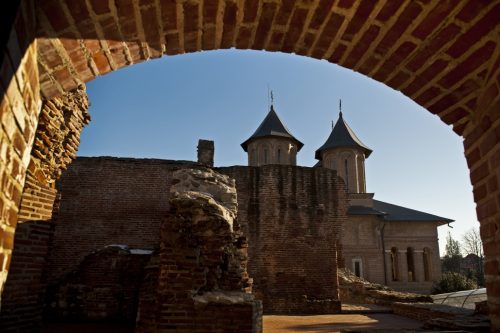
We’re following Vlad III to Târgoviște, his father’s princely court that, at least this time, proved to be a cold and lonely space when young Vlad arrived to reclaim its most-wanted throne.
To understand Vlad Dracula we should visit more than his fortresses. We should search the Ottoman courts as well as the Wallachian and Transylvanian cities that harbored him. Additionally, the roads, mountain passes, and foreign paths that influenced his life.
The places where he lived tell part of his story. But the places where he was held, fought, fled and returned to – tell the rest.
With his father, Vlad Dracul, and elder brother Mircea killed, Vlad became heir to a shattered inheritance: his throne was already contested by his enemies.
Until now, Anatolia had been the landscape of his captivity alongside his younger brother Radu. Târgoviște was merely the place where his family had been destroyed.
From now, the two Draculesti brothers would take very different paths.
Radu became increasingly associated with the Ottoman court and with Mehmed, the future conqueror of Constantinople.
Later accounts portray Vlad as difficult to control and hostile toward his captors. Readers should approach the more dramatic stories of his captivity cautiously. Most tales were written or embellished after his death. This risks turning captivity into a convenient explanation for the adult prince’s cruelty.
The historical reality surrounding the return of Vlad III to Târgoviște is powerful.
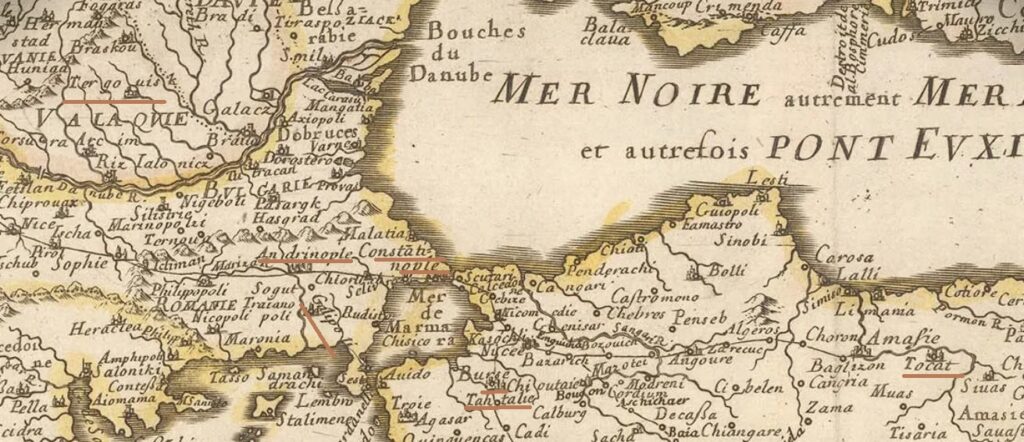
Vlad was a Wallachian prince held hostage by an empire threatening his homeland. Alone. During those formative years, he learned the language of his future enemies and became familiar with their customs, military culture, and system of authority. He also witnessed how power could be organised, enforced, and used to rule – and to inspire fear.
He also learned what it meant to have his freedom taken away. To be at the hand of plotters and of higher powers.
When Vlad eventually returned to Wallachia, he would carry Anatolia with him—not merely as a memory of captivity, but as knowledge: knowledge of the enemy, knowledge of unquestionable power, and knowledge of the price of weakness.
In the years to come, that knowledge would become one of his most formidable weapons.
When Vlad emerged from Ottoman captivity in 1448, the world to which he returned had changed beyond recognition. Vlad III was no longer a hostage waiting on his father’s political fortunes, but a prince returning to a country where the throne was both his inheritance and his battlefield.
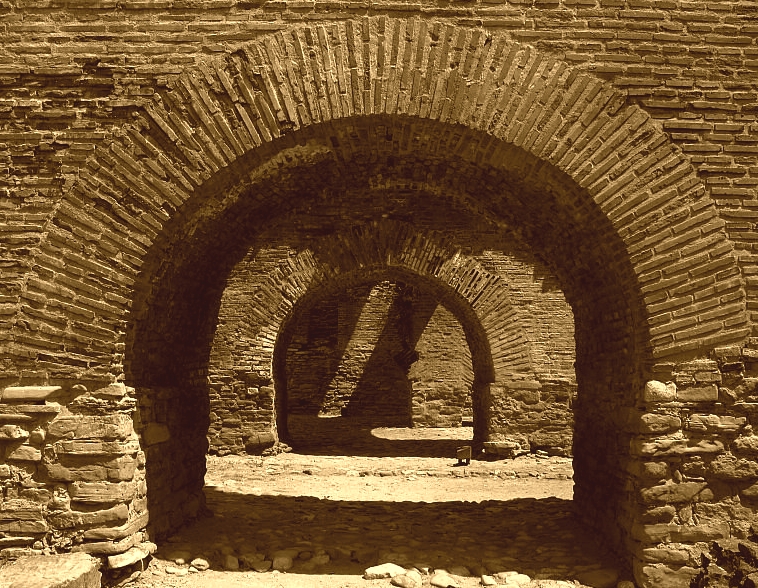
1447–1448: From Captivity to His First Reign
At the end of 1447, Vlad’s world changed. His father, Vlad Dracul, was killed near Bălteni, while his elder brother Mircea was captured at Târgoviște by boyards, blinded, and buried alive. At John Hunyadi’s will (by then elevated to the Governship of Transylvania), the Wallachian throne passed to Vladislav II of the opposing Dănești line.
Some historians claim that Sultan Murad II himself told Vlad III of his father’s death. A Romanian tradition speaks of a messenger who rode from Wallachia to Adrianople carrying his dead father’s sword, cape and Dragon Order insignia. Neither account can be firmly established, but both preserve the essential reality: Vlad suddenly had a family revenge.
What is sure is that in 1448, with Ottoman support, Vlad III returned to Wallachia, to the princely court of Târgoviște, and made his first attempt to claim his father’s throne.
It was going to be a short first reign.
Yet his return marked a decisive turning point. The hostage had become a claimant, and Wallachia’s disputed throne had drawn Vlad into the political struggle that would define much of his life. To reach it, he would have to navigate the same powers that tormented his father and surrounded his homeland—and, increasingly, use their rivalries to his own advantage.


The arrival of Vlad III to Târgoviște: The First Reign, 1448
Vlad was still within the Ottoman sphere when the opportunity arose. A Serbian-born Janissary officer later described how Sultan Murad II supported the young prince:
“Hearing of the death of the Wallachian prince, the Turkish Emperor bestowed gifts upon his oldest son: money, horses, jewellery, tents as fit for a ruler and sent him in Wallachia to rule instead of his father…”
The Ottomans expected Vlad to offer homage and tribute to their sultan, as his father had done, while his younger brother Radu remained at the Anatolian court. Young Vlad’s return, therefore, was not that of an independent ruler. Ottoman support enabled him to cross back into Wallachia and challenge for the throne.
The precise return route is uncertain, probably via Giurgiu, but by late September 1448 Vlad had entered Wallachia while Vladislav II was away with his forces, accompanying Hunyadi’s campaign against the Ottomans. Târgoviște, the princely capital, became the centre of Vlad’s first, brief reign.
Codrii Vlăsiei (Vlăsiei Woods) was a lush forest that, during the 15th century, covered parts of southern Romania. Vlad would have traveled through it:

Vlad’s presence at Târgoviște is confirmed by a remarkable letter dated 31 October 1448, addressed to the officials of Brașov—the earliest known document issued by Vlad Dracula. Writing as a newly installed prince, he urged the city not to act against him while the outcome of Hunyadi’s campaign remained uncertain:
“If we came now to him, the Turks could immediately destroy both us and you.”
He proposed waiting until the result was known:
“If, however, he comes out safely from the war, we shall meet with him and make good peace.”
Despite the threat beneath his words, Vlad closed the letter with striking courtesy, calling the men of Brașov:
“your brother in all things”
“brothers and dearly beloved friends.”
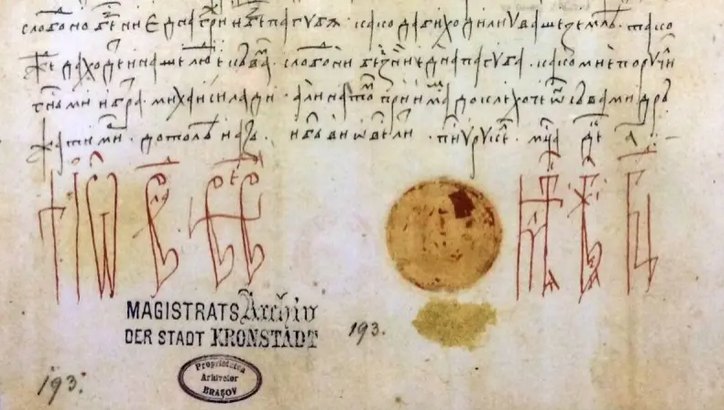
The letter reveals a young ruler already navigating the dangerous space between the Ottoman Empire and the Hungarian kingdom. He had returned with Ottoman backing, yet understood that he could not afford to alienate the Saxon towns of Transylvania.
Later Ottoman chronicles also associate Vlad’s installation in Wallachia with the sultan. One says Murad:
“[the Sultan] put the son of Dracul, Tēpeş, as a bey”
while another records that the Ottomans:
“put Dracula-oglu Kazîklu as lord in Wallachia.”
On the plan below, showing the different stages during which the princely court at Târgoviște was built, we can spot A and D (with G built during his second reign) that would have existed during the time of Vlad III:

Although these later accounts cannot establish the exact chronology, they reinforce the contemporary evidence linking Vlad’s first return to power with Ottoman support.
Vlad’s first reign lasted only weeks. After Hunyadi’s defeat at Kosovo, by early 1449, Vladislav II returned (helped by an army of Moldavians led by Peter Aaron) and reclaimed the throne. Vlad was forced to flee, travelling north towards Moldavia.
Although his first reign had been brief, but its significance was not. At seventeen, Vlad had crossed from captivity into Wallachia, entered Târgoviște, claimed his father’s throne, and issued orders in his own name.
He had become a ruler.
And he learned at last one of Wallachian politics’ hardest lessons: he could take the throne through force and foreign backing. Keeping it was another matter entirely.
But, for now, Vlad was on the road again.

Vlad III will return to Târgoviște during his second reign, the longest one. Those were the years when he reinforced many of his princely courts, Târgoviște as well as Bucharest, and when he fortified Poenari Castle.
Book 3 (out 2027) in my Blood of Kings, Heart of Shadows historical fiction saga delves in this time of Vlad Dracula’s life.
But you don’t have to wait so long to discover how I imagined Vlad Dracula at age 19:
Vlad III, Young Vlad, Vlad the Impaler (Țepeș), Vlad Dracula, or Kazıklı Voyvoda (Impaler Prince)? Do you know?
We know from letters that his father, Vlad II, called him Vladul (Vlad-ul meaning The Vlad).
Vlad did not originally call himself Dracula. The name came from his father, Vlad Dracul, whose title was associated with the Order of the Dragon. Vlad later adopted the patronymic Drăculea—“son of Dracul”—and by 1475 was signing documents as Wladislaus Dragwlya.
Impaler, Țepeș, was a name given to him later, because of his supposed preference for impaling. In contemporary sources, both foreign and domestic, he is never called by this name. It was not until 1508 that we find him referred to as Țepeș in an external document and again in 1550 as “Vlad voevod Țepeș.”
The Ottoman form Kazıklı Voyvoda (Impaling Voivode / Impaler Prince) appears in Ottoman sources at the beginning of the 16th century.
Next time, on September 17 we will follow Vlad III in exile, in Moldavia and Transylvania, and discover all the places where he lived between 1449 – 1456.
About the research:
Patricia Furstenberg is a Romanian-born historical fiction author whose Blood of Kings, Heart of Shadows series explores medieval Transylvania, Wallachia and Moldavia. Her research takes her into the history, folklore, landscapes and forgotten stories behind the fiction.
Your usual spot-on attention to research and detail here, Patricia. Thanks for sharing this section of Vlad’s life. 🙂
Hugs, Laura. Thank you so much 🙂 I found it Impossible to publish a string of photos with no explanations… 😉 Ha ha – how else. xx
What a world that was. Tough doesn’t begin to describe how you had to be to survive.
Absolutely! And among all that hardship were some remarkably gutsy women 😉 – resilient, resourceful, and far tougher than history often gives them credit for.
This is fascinating. My previous knowledge of Vlad, years ago, made him almost a caricature. You have put flesh on the bones of the cartoon and made him human. I’m reading The Book that should have been Lost at the moment. It makes for compulsive reading!
I know what you mean, Trish. If I think of my history book… all legends.
I left out a lot here, but he was a human being, nevertheless. And I don’t think he ever stood a chance in choosing his dreams over the dreams chosen for him.
Bless you for sharing that insight. You made my day!! 🙂
Fascinating! I had to go back and read the previous parts of your Vlad III series. This is an area where I’m lacking some knowledge. I have studied the Crusades and the history of Christianity, but there is so much more. I purchased three history books: The Classical World, Medieval Europe, and Osman’s Dream: The History of the Ottoman Empire. Hopefully, I’ll get a good historical picture after reading those three books. The way you write stories is amazing. I guess I need to thank Debby’s book review for finding you. Thank you, and I hope you have a great weekend.
Thank you so much for your kind words! I’m delighted Debby’s review led you here. And those three books are an excellent way to broaden the picture, although your knowledge is impressive.
“Osman’s Dream” in particular will add fascinating context for understanding the Ottoman world surrounding Vlad and the lands through which he travelled. I hope my Vlad III series brings some of those historical connections to life along the way. Wishing you a wonderful weekend, and happy reading!
You’re very welcome, and thank you, Patricia.