In the Carpathian lands wood was never only material. It was a way of life, forest turned into geographical landmark (Transylvania, Trans-silva, the land beyond the forest). Wood was shelter and church, and then it became memory.
With the arrival of German Saxons in Transylvania during the middle of the 12th century, the craft tradition of painted furniture started out of with necessity before it became decoration. Colours arrived later, as an afterthought to survival.
And yet it is colour that outlived so much else.
In my novels When Secrets Bloom and Beneath the Snow I draw on this medieval Saxon tradition: not as background detail, but as silent architecture beneath the lives of my characters. Because painted wood is never passive. It tells as much as it remembers.
The forest before the object
In Transylvanian Saxon households everything begins within the forest.
Oak for strength. Beech for stability. Fir and spruce for reach and abundance. Walnut when something darker, more enduring, was required. These were never aesthetic decisions in the modern sense but negotiations with terrain.

Wood is never uniform. It twists, it bleeds resin, it resists the axe. And so the craftsman’s first act is not creation, but correction.
Knife. Scraper. Stone. Sand.
Only then did the surface becomes quiet enough to receive anything at all.
The silence before colour drops
Before any image could exist, the wood is sealed into stillness.
The Saxon workshops used what can only be called domestic chemistry: materials drawn from kitchen, field, and animal alike. Sour milk thickened with lime. Casein from curdled milk. Egg yolk emulsified into unstable permanence. Bone and hide glue, boiled into something between liquid and memory.
This layer was not visible once finished. But it ruled everything that came after. Without it, pigment would disappear into the grain like rain into soil. But with it the surface becomes receptive, like a paper waiting for ink.
The choice of pigments in a constrained world
The Saxon palette was not expansive. It was disciplined by geography.
Red came from ochre and iron-rich earths.
Yellow from mineral deposits, sometimes intensified into sharper, almost metallic tones.
Black from soot—often conifer smoke collected and ground fine as breath.
White from chalk, gypsum, or diatomite.
Green from copper compounds, unstable and alive in their chemistry.
These were not pigments of abundance. They were pigments of endurance. Each one carried the memory of extraction: dug, burned, ground, or coaxed from raw matter.
And, occasionally, in more experimental hands, colour drifted into deeper uncertainty: organic dyes that faded or shifted with time, refusing permanence.

When furniture becomes landscape
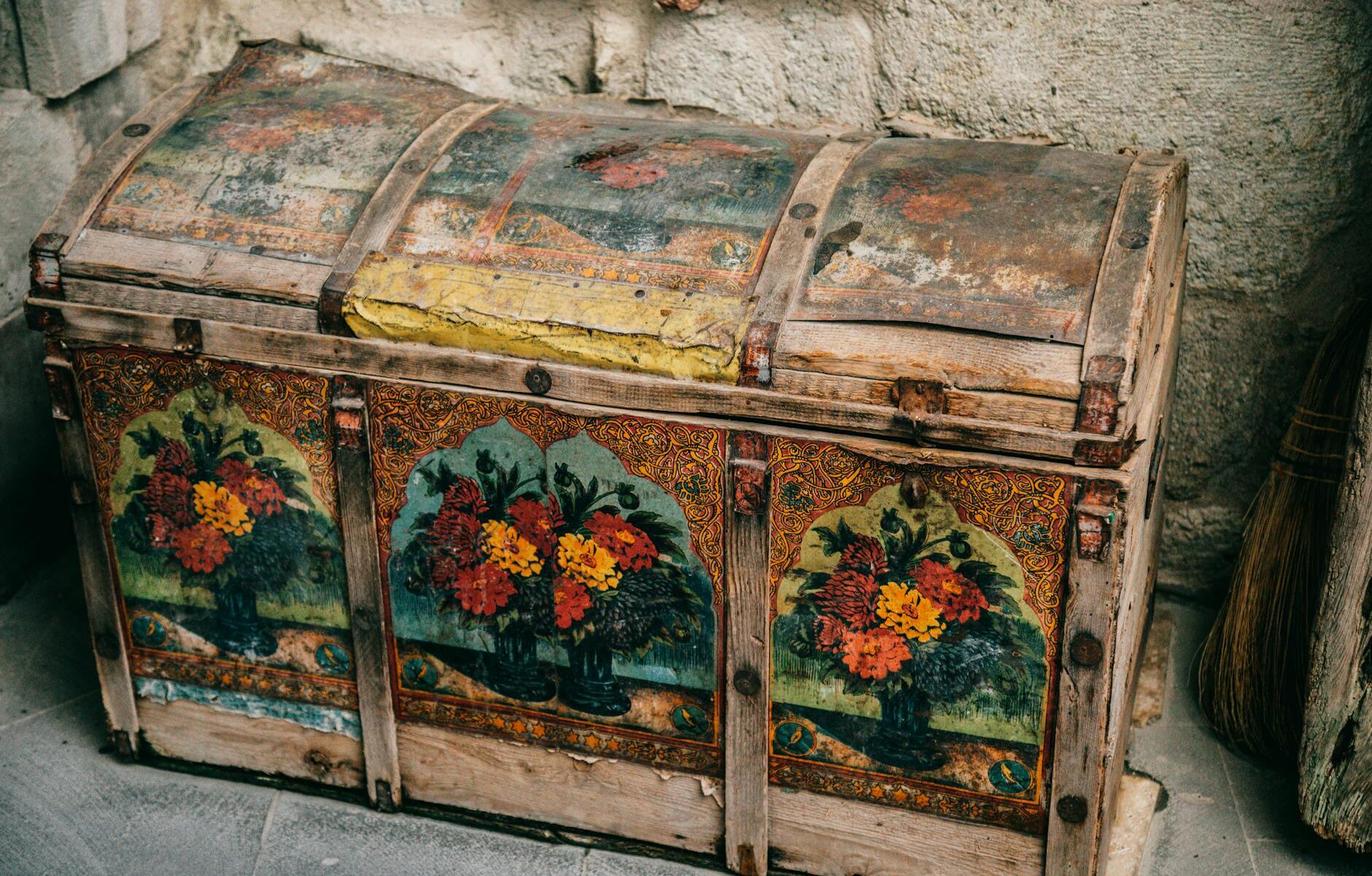
A painted Saxon chest is never just storage.
It is a field of symbols, often arranged in strict symmetry: floral forms, rosettes, scrolling vines, geometric containment. The imagery is never purely decorative. It is protective. To paint wood is a gift, the gift to hold chaos in place.
A chest might contain linen, grain, or bridal possessions. But externally it presented order—an assertion that life, despite its fragility, could be arranged into stability.
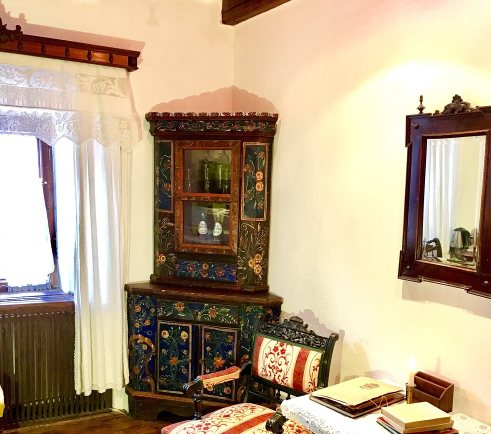
In many homes these chests are still the most visually dominant objects in the room. Their surfaces carry entire philosophies of survival.
The crocus and the illusion of spring
One of the most persistent motifs in Saxon painted furniture is the flower. Not botanically precise. Not observational in the modern sense. But symbolic, reduced to essence: petal, stem, repetition, return.
A crocus painted onto wood in this tradition is not a study of nature. It is a refusal of winter.
Yellow ochre layered over pale ground.
Edges warmed with burnt earth tones.
Stems drawn in copper green or soot-blackened line.
And always the sense that the flower is less growing than remembered. It does not bloom so much as insist.
The crocus is the artist’s declaration that spring exists even when it cannot be seen.

The unseen labour of preservation
Once painted, the surface is sealed again.
Firnis (an oil-and-resin varnish, sometimes thickened with beeswax or later gum arabic) is brushed over the finished work. It deepens the colour, darkens the tone, and binds everything together into a unified skin.
But it also changes time. Because over years these surfaces did not simply age, they matured. Colours softened. Reds deepened. Whites dulled into bone. The object stopps being new and accumulates atmosphere.
It becomes something closer to weather than to furniture.
The domestic cosmology of the painted home
To understand Saxon painted wood is to understand a world where nothing was purely symbolic or purely functional.
Milk became binder.
Earth became colour.
Forest became structure.
Household labour became preservation of beauty itself.
Even the act of painting is not separated from survival. It is part of it.
A painted plank above a sleeping place, for example, is not mere decoration. It is an insistence that even the underside of a roof deserves attention. That beauty should exist where exhaustion resides.
To lie beneath it is to live inside an argument: that life, however difficult, should still be marked by care.
Yet very little survives change. Wood cracks. Pigments fade. Furnishings are repurposed, burned, repaired beyond recognition.
And yet the idea persists.
That wood can be more than shelter.
That colour can be more than ornament.
That a household object can carry within it a kind of quiet resistance to forgetting.
In When Secrets Bloom, these objects are never silent. They are witnesses. They hold the residue of hands that prepared them, and the lives that passed beside them.
A painted chest is never only a chest. It is a fragment of forest made to endure indoors. A reminder that the world outside (earth, sap, mineral, and season) is part of the one inside, and within. Or rather the other way around 🙂
Fascinating, Patricia, and so beautiful. So wonderful that the pieces shown in the pictures have survived to tell their tale. Many thanks for sharing. 🙂
Yes, it is exciting and also to knownthat this kind of art is still used and learned. So good to know it won’t dissappear.
Some of these chests go for nearly one thousand British pounds.
They look worth every penny, Patricia. 🙂
This really is an interesting article, Patricia.
Oh, I can tell this is the artist in you spweaking, Roberta 🙂 Glad you enjoyed it.
️
There is always so much to take away from your content and posts – like this today about wood: “Wood is never uniform. It twists, it bleeds resin, it resists the axe. And so the craftsman’s first act is not creation, but correction.” so interesting
You are too kind, Yvette. Thank you so much 🙂 I think the closest we come to this kind of tradition is through the use of reclaimed wood. There, we can see the bends, the knots. But not as much the patience of the craftsman.
Thanks for sharing this fascinating information!
Thank you for your kind words, Dawn. I am so pleased with your visit 🙂