
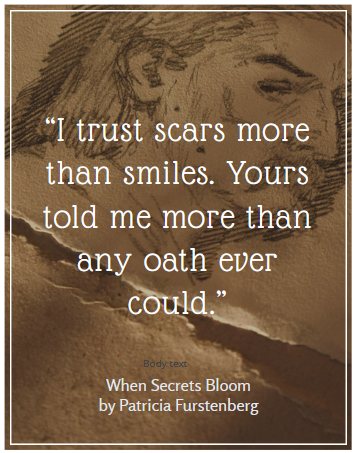
“I trust scars more than smiles.” At first, it sounds like the kind of sentence one should not agree with: “I trust scars more than smiles. Yours told me more than any oath ever could.” (When Secrets Bloom)
Scars Tell the Truth Lies Never Can
It is a strange kind of education. There are things we are taught to believe about people. Faces. Voices. The ease of a gesture held too long or too carefully. We are trained to read them as if they are stable texts, written in a language that never changes.
But people are not stable texts. They are disputed ones.
History is full of this failure of reading.
Vlad Țepeș, a ruler once rooted in the complicated soil of Wallachia, did not remain a simple man for long, not in the public imagination. Through pamphlets and printed woodcuts that spread across 15th century Europe Vlad the Impaler was gradually revised. His personality edited into something simpler, something easier to fear.
“Dracula” was not a discovery of truth but an accumulation of repetition. Ink did what armies often do: it redrew borders, this time drawing them around a reputation.
What survived such rewriting was not always the truth, but the most printable version of it.
And yet the body refuses to be printed.
“I trust scars more than smiles. Yours told me more than any oath ever could.”
A scar does not translate easily into rumor. It does not survive the when the language is twisted in press, not in the same way a name does. It does not grow cleaner or darker depending on who repeats it. It simply remains; fixed, anchored to the place where something once broke.
Smiles can be performed. So can innocence. So can cruelty, at least in the telling of it.
A man can be called cruel in a pamphlet and have that cruelty outlive him by centuries. A woman can be described as cold, proud, unkind, a witch and the words may travel further than anything she ever actually did. Name-calling has always been efficient that way because it requires no proof, only repetition.
But a scar is resistant to repetition.
It does not grow louder when retold. It does not change shape to suit the listener. It remains fixed in the body of the person who carries it, a private record untouched by public opinion.
That is why trust shifts away from what is said and toward what survived. Not because speech is always false, but because it is always vulnerable to distortion. Whereas the body (marked, changed, altered by experience) cannot easily be rewritten to suit someone else’s agenda.
A scar does not travel without its owner. It cannot be detached, copied, or improved upon. It simply is. A scar, then, becomes something more than damage. It is testimony that cannot be bribed, reshaped, or printed into myth.
And in a world where reputations can be built from paper and destroyed the same way, in its refusal to be falsified a scar becomes the only form of truth that refuses to travel without the person who lived it. As simple as that.
wow – that post really has me thinking – ! and esp this: “And in a world where reputations can be built from paper and destroyed the same way, in its refusal to be falsified a scar becomes the only form of truth that refuses to travel without the person who lived it. As simple as that.”
I am so glad it resonated with you 🙂 Yes, during medieval times too, falsifying someone’s life was happening all too often.
Thank you for sharing your thoughts.
Very true, Patricia. People have been condemned on false testimony – like accusations of witchcraft – which they can’t disprove, bur scars tell their own story.
Yes, yes, and we think alike here. Thank you, Laura. 🙂
I think I may have more songs on my phone that mention scars than I do that mention smiles, for instance:
― “You should see my scars” ― Garbage, “Bleed Like Me”
― “Underneath every scar there’s a battle I’ve lost” ― Metric, “Eclipse”
― “Scars of pleasure / scars of pain / atmospheric pressure makes them sensitive again” ― Rush, “Scars”
Of course, I do also have a song called “Smile” by The Jezabels, but that’s explicitly about NOT smiling and how you shouldn’t tell her to smile if you don’t know her, brother; for all you know she just buried her mother.
I appreciate the reference to music. Scars and smiles definitely echo there. I listen the the three songs and I’m familiar with Garbage. Probably the oldest on the list 🙂 which explains.
The reference to empathy there is quite powerful.
But my feeling is that empathy, the way we understand it today, was not a thing in medieval (Eastern) Europe. Although people did care. Maybe on a different scale. A binary scale.