
Let’s step into historical Brașov, Transylvania, the city that inspired When Secrets Bloom, my latest historical fiction novel. We’ll take a peek at: a mysterious old shop, the three old maids (houses) from Council Square, and the haunting Black Gate.
Transylvania: the name stirring the mists, blood-soaked legends, and old superstitions.
But walk through Brașov’s Old Town and you’ll hear a different story begin to stir. Here, cobbled streets wind between facades that wrestled time and love so often, the past still clings to rocks like lichen.
Maybe you will trace your hand over the soot-stained stone of the Black Church or what’s left of the old city gates, or linger beneath the vaults bordering Council Square. Maybe you’ll be lucky and the wind will share with you whispers of trade, treason, and quiet resistance. And you will wonder if you half-heard, imagined, or read it in a book.
Here, in old town Brașov, history still lives in the scent of wind; in the echo of rope-thin alleyways, and in the dignity of a fortified fortress that, too often, fought back Mongol and Ottoman attacks.
This is not the Transylvania of myth, but the one that endured. The one that inspired my historical fiction When Secrets Bloom. Especially an abandoned shop, three medieval houses huddled in Council Square, and the memory of Kronstadt Fortress’ medieval Black Gate.
1. The old shop that inspired the Fro Rivka’s printing press
“Moise paused on the threshold, stomping and brushing himself off. The old wooden building, with its weathered planks, stood stoically against any weather. The carved sign above the door depicted an eagle with outstretched wings, a symbol of guardianship. Beneath the majestic bird was a crown with seven points representing Siebenbürgen, a nod to Kronstadt’s status as one of the first seven Saxon cities established by Saxons in Transylvania. Below the crown, a wreath engraved with the words ‘Veritas et Sapientia.’ Truth and Science. The motto had always symbolized the pursuit of knowledge and integrity. He was about to push the burnished door when it opened as if by magic.” (When Secrets Bloom)
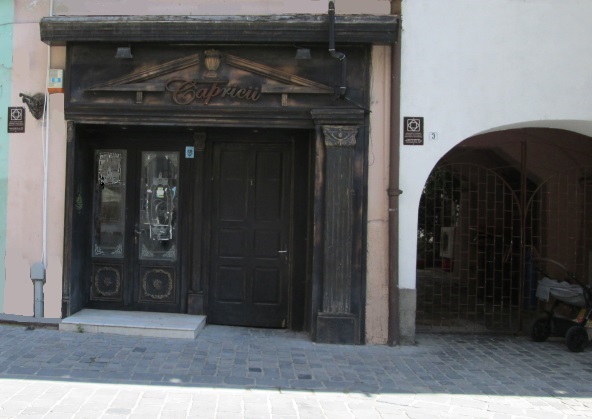
It It was a lazy summer afternoon, the kind where the heat seems to still the world and you gave up hunting for history, hunting shade instead. Footsteps echoed softly, each one following its own path. Lost, but not quite, in a city hundreds of years old. Stone and shadow. Silence and sun. The past felt close enough to touch.
That’s when I found it. This old shop off a street from the Council Square.
It hunched between brighter façades as if trying to be forgotten. Along the way I’d been searching, perhaps not deliberately, but instinctively, for the real-life spark behind the printing press in When Secrets Bloom. And there it was: a centuries-old building (it has a Historical Monument sign on it) tucked like a secret that hadn’t quite managed to vanish.
I rested my hand on the worn stone and felt that steady pulse of purpose, of survival. Standing there in quiet heat it wasn’t hard to imagine Fro Rivka behind its door. Her fingers ink-stained. The front room cramped with shelves. Her press hidden in the back, where each printed word was both an act of courage and an offering to the future.
2. The three old maids in Council Square: the Magistrate’s house, the first Pharmacy, and the corner building with porticoes
“It was the new residence of the judex civitatis, the Magistrate of Kronstadt. Moise had always been intrigued by this place and by the two adjacent houses, all distinctively set back four steps from the alignment of Council Square. This peculiar structure – a testament to the town’s intricate urban planning – was said to be necessary to maintain open access to the courtyard behind, that of the Church of Saint Mary. No harm in that, but Moise also suspected that it’s been paid for in gold. Probably public gold. As with all good civic projects: designed in the name of the people, funded by the people, yet curiously always built just far enough away from the people. The Magistrate’s residence boasted a wide, arched doorway
Adjacent was the house of old Johannes, the pharmacist, marked by the etched emblem depicting a mortar and pestle.
Finally, to the right was a narrow space occupied by porticoes, their wooden beams supporting an overhang that shielded the way below. On rainy days, merchants set up stalls there, their goods spread out in a colourful array beneath sheltering eaves. By night, the same space became a romantic enclave where lovers exchanged whispered promises and bargained kisses.” (When Secrets Bloom)


Pause with me in front of these three 14th-century townhouses — still standing, still joined — whose foundations may well echo the footsteps of historical characters, both imagined and real.
At first glance the historical past of the trio of buildings at Nos. 15–17 in Brașov’s Council Square (once called Mart) might be just another row of colorful facades smiling carelessly near the grandeur of the Black Church. But step closer and you’ll find layers of history humming beneath the plaster and stone, each one whispering a different tale.
These are the Closius–Hiemesch–Giesel Houses (as they were later known), initially just residential buildings from the Short Row (Kurze Zeil am Ring), a name that hints at their tightly woven structure and their pivotal place in medieval Brașov.
Their story begins in the 14th century, when three distinct houses stood here, each with its own doorway, each holding its own secrets. Over time their walls fused and their lives entwined, until they became a single architectural body: a living manuscript bound in stone.
Set back deliberately from the square’s main line, they made room not for grand designs but for access to the Black Church courtyard.
Yet history, like medicine, evolves. Here was, indeed, located the real first pharmacy of then Kronstadt (Brasov), first mentioned in documents from 1512. On March 4 and June 1, 1520, Brașov’s magistrate paid Johannes the pharmacist six florins and twelve aspers plus the taxes on his home. This wasn’t just generosity; it marked the city’s official recognition of its first full-time “aromatarius,” a healer of herbs and tinctures, vital in an age when plague could strike like a storm.
In such prime location it’s been easy to imagine the Magistrate’s House next-door, as well as Gothic arches to protect merchant stalls.
Here, life was not just lived, but plotted, endured, and remembered. These walls held not only treaties, but treatments, whispered truths and, perhaps, the ingredients of a good historical novel.
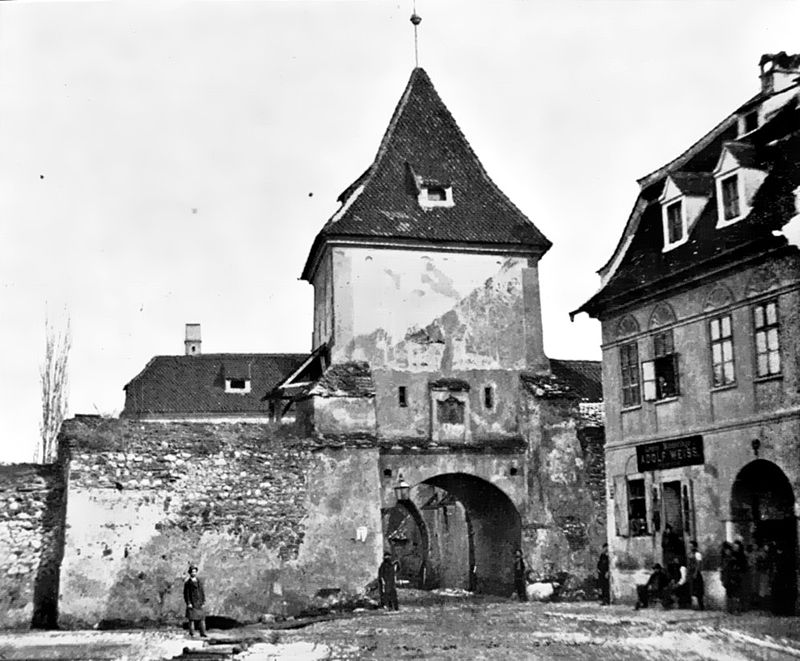
3. The historical Schwarzgasse of Kronstadt, the Black Gate
“The driver took every shortcut, threading through narrow paths and skirting the bustling roads, yet still pressing eastward toward Schwarzgasse, the Black Street with its dark gate. At each crossing, the faint murmur of water reached my ears, its trickling song carried on the wind. It felt as though the world aligned, my final ride following this dark stream, its waters long stained by the refuse of time, giving it its murky hue. The sound of the current was a soft lament as though even the stream mourned the passing of something, bearing the weight of the past along its shadowed course.” (When Secrets Bloom)
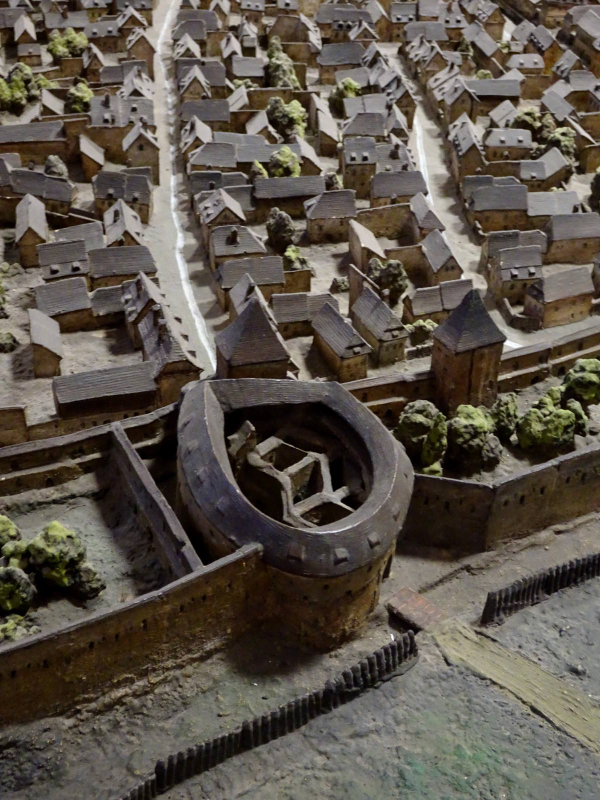
If one seeks the cradle of Corona, medieval Brașov, one must look to the shadow of the Black Church, once known as Saint Mary’s, and to the open expanse of the Council Square (Piața Sfatului), where the cobblestones still remember the clamor of merchants and the deep toll of the hour bell.
Once upon a time the Schei stream, with its bifurcated flow, carved its course through the settlement leaving behind a gravel bed, the prund, which, over time, would become the very heart of the square, Piața Sfatului. Soon after main arteries traced the ancient paths that once linked this fortress to trade regions and roads formed by the will of merchants as by the lay of the land.
To the south-east of this area, the terrain formed a thick and convoluted district. Then, three narrow, nearly parallel streets run through this nook like veins beneath ancient stone. one of them, Schwarzgasse (today Nicolae Bălcescu Street), stands out not just for its size, but also for its powerful presence. Many experts believe that its great breadth, which was exceptional for the time, originally served as the spine of a vibrant commercial sector, where foreign voices mixed with local chatter beneath timbered balconies and hanging store signs.
The tanners, or pielarii, were settled in this edge of the fortress, downstream from the main settlement. They made use of the stream flowing openly. The waste from their trade, poured into the water, darkened its flow. It is said that this may be the origin of the street’s former name: Schwarzgasse—the Black Street.
At its end, the Black Gate, was a secondary portal in the city’s defended wall, but had vanished by the end of the 18th century.
Brașov was a city with several gates, each one a portal to another world.

Places like this don’t just inspire stories, they are stories. They wait, patient and undemanding, until someone listens. And then, they show not just what once was, but what could have been. These are the echoes that shaped When Secrets Bloom and they still linger in the hush of Brașov’s oldest corners.
Thank you for joining me.
That is beautiful and intriguing writing. I was in Brasov in 2008, a long time ago, but I remembered a few things you mentioned like the Black Church and the Council Square and I recognized a few buildings in the photos. I remember I was standing up on the nearby mountain looking over Brasov as I started speaking to a Norwegian. The others could hear that our languages were different (Swedish vs Norwegian) and they thought it was funny that we kept speaking as if that did not matter. Well Swedish and Norwegian are close enough that it is difficult to understand each other and yet they sound different.
Thank you so much for your kind words. I’m glad the writing stirred a memory. Brasov has that timeless quality, doesn’t it? The Black Church and Council Square seem to anchor the whole city in a shared past, waiting quietly for each visitor to find their own thread in the tapestry.
Your story made me smile. What a lovely, human moment, speaking across languages that are near-twins yet distinct. I imagine the mountain air and the view over the red roofs made that encounter even more memorable. Isn’t it remarkable how certain places invite connection, not just to history.