
There are truths history rarely writes plainly about. Skill, in the wrong hands — or rather in the wrong body — becomes suspicion. And knowledge, instead of opening doors, invites them to close.
In many places, across many centuries, a woman who knew too much was not admired. She was watched. Questioned. Named.
And once named, rarely forgiven.
“Yet for all my knowledge I was still only a woman. And that was my crime.”
This line does not cry out in anger. It does something far more unsettling: it states a fact, as it was lived. The quiet injustice of it reaches deeper than any accusation. To heal, to understand, to act with certainty… and yet to be reduced, in the eyes of others, to something lesser. Something dangerous.
Not because of what a woman did. But because of what she was.
In a world like that guilt is not earned. It is assigned.
Pure jealousy over a skill someone had while someone else lacked? Over the power such healing talent conveyed? Fear? Or simply a misunderstanding? The reasons are as varied as the herbs that grow wild, each with its own hidden purpose.
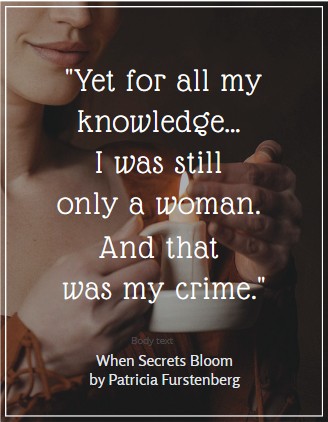
“Yet for all my knowledge… I was still only a woman. And that was my crime.” (When Secrets Bloom by Patricia Furstenberg)
Hi Patricia, I cannot be a woman, because I’m a man!! From Tak Hiemstra
Hi Tak — fortunate for you, that spares you the charge entirely. I’m afraid the quote isn’t quite so forgiving to the rest of us. Thanks for stopping by.