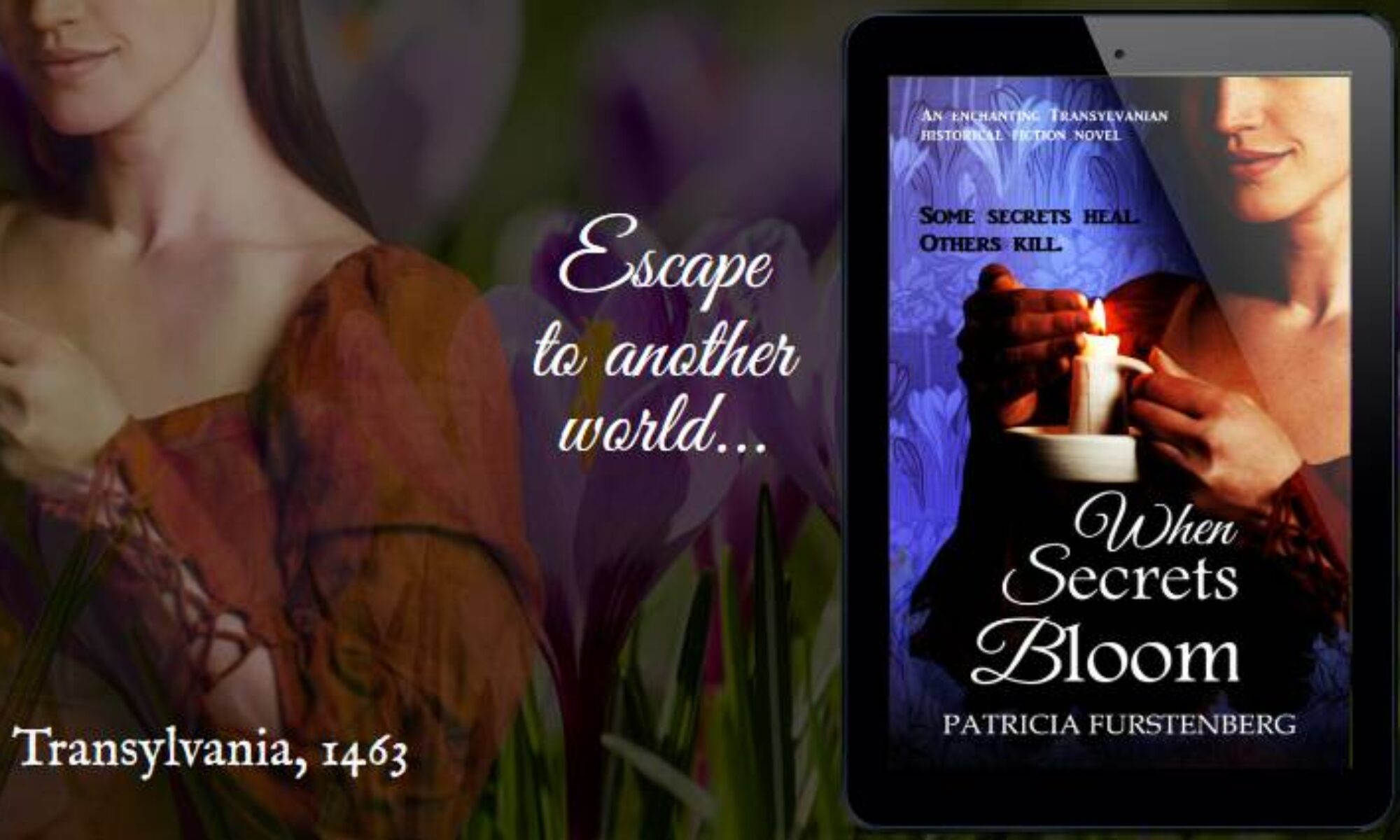
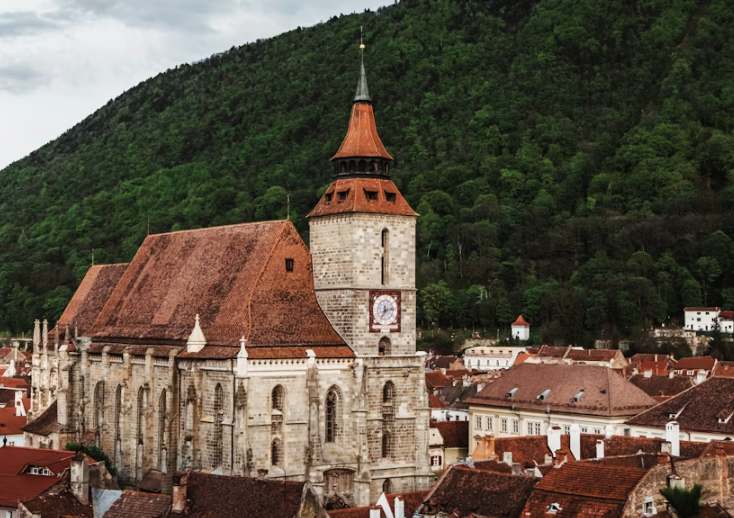
There are cities in Transylvania that do not simply sit on the map, they remember. They carry the sediment of centuries like bark around an old trunk. Brașov, know as Corona or Kronstadt in medieval times, is one of those places. In When Secrets Bloom Brașov does appear only as a backdrop. It breathes. It resists. It watches.
Because to write about a place is to write against forgetting.
Readers will discover Brașov as a setting in my story Kate’s Letter featured in our historical fiction anthology Courage: Tales of History, Mystery and Hope.
The medieval heart of Brașov—known to German settlers as Kronstadt—begins not in silence, but in movement: colonisation under the royal sanction of King Andrew II of Hungary who donated of Bârsa Land (then part of his empire) to to the Teutonic Knights in 1211 (to protect the far eastern borders of his realm).
This land was repeatedly named, claimed, renamed again. It was first known as Corona (the Crown City) in the 13th century records, tied to catholic religious orders and early settlement structures. But just a few years later (in 1241) Tatar invasions sweep through in the spring on their route to central Europe. Soon after it mentioned as Terra Saxonum de Barasu and Corona is its political and administrative centre inhabited by Hungarian noblemen, Saxons and Romanians.”
By now it hardened into something unmistakably urban: crafts, guilds, markets, privileges, and stone slowly replacing wood and earth. Even the catholic council moved here. By the 14th century Kronstadt is no longer emerging. It is asserting itself, receiving full privileges at the beginning of the 15th century – administrative autonomy, tax exemptions, free elections of leaders and priests, and the right to hold annual markets, use the land, rivers, and forests freely. As well as to provide army if the Hungarian King demanded.
In fiction, such a city cannot be treated as ornament. It must be allowed to glow through the narrative.
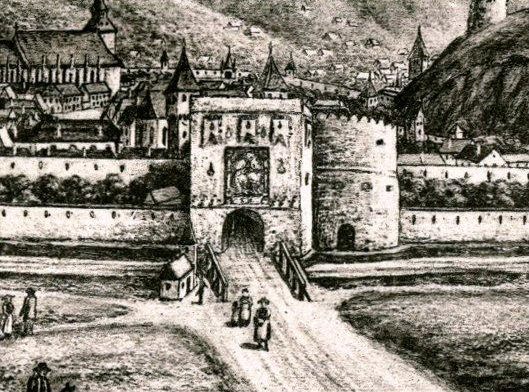
“The Monastery Gate, known as Customs Gate, was one of the
four official entry points in the fortress of Kronstadt and the
one where Wallachian and Moldavian merchants paid their
tolls to gain entrance. […] Over the archway, a magnificent
painting in vibrant hues still depicted Emperor Sigismund of
Luxembourg — the very ruler who, a generation ago, had
ordered the city’s fortification. While on the city side, a sundial cast its shadow, urging the Kronstadters to mark the passing hours. It served as a solemn reminder of the moment they left the fortress through gates that both
offered protection and, with the setting sun, sealed them away.”
(When Secrets Bloom, Patricia Furstenberg)
What matters is not only what the city is, but what it has survived to become. Fortifications rise—walls, bastions, towers entrusted to guilds like living organs of defence. The city encloses itself not out of isolation, but necessity. Siege architecture becomes civic identity. Even the churches and squares are shaped by the logic of protection, endurance, vigilance.
For example the Brassovia Fortress built on the saddle of Tâmpa Mountain, reinforced with thick all, a well, a chapel, and numerous underground cellars where food supplies were kept all year round. It was meant as a refuge for the inhabitants of Kronstadt, in case of foreign evil attacks. John Hunyadi had it demolished by the beginning of 1455.
And always the tension of presence: with three suburbs outside the walls of Brașov: one
inhabited by Romanians at the edges of documentation and recognition (Scheii), one by Hungarians representing the authoruty (Blumăna ) and the third one by Saxon guilds (Altstadt).
This multiplicity is what makes Brașov / Kronstadt a fertile ground for fiction.
In When Secrets Bloom that layered identity becomes more than historical texture—it becomes psychological terrain. The city’s divisions echo inward, into characters who also carry fractured belonging.
“‘Instincts led me away from ruin.’
‘But into a name that’s not yours. You’re a Saxon girl.’
‘And you are a Vlach. Names are like cloaks. They cover what needs hiding.’
‘And what is it you’re hiding, Kate?’”
(When Secrets Bloom, Patricia Furstenberg)
One of the most powerful locations to work with is the Black Church district — today known as Honterus Courtyard. Today it marks the oldest built area in Brașov, believed to be the site of a monastery linked to the first recorded mention of the settlement as Corona in 1235 as well as a school (just as the one mentioned in the Book 2 of my book series.)
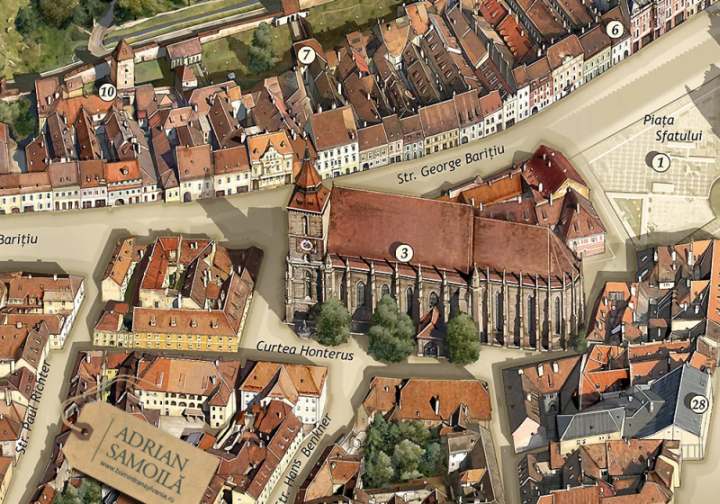
Historically, it grew from a dense concentration of religious, educational, and civic life: churches, chapels, school buildings, parish houses, and administrative spaces pressed tightly into one shared enclosure. Fire, earthquake, reconstruction—each layer leaving behind remnants rather than erasures.
If you trace the story of this church back, it begins with a Romanesque structure in the 13th century—one that didn’t survive the Mongol invasion of Europe. The building we see today started rising in 1383, when Brașov—then known as Kronstadt—was thriving on the frontier between Transylvania and Wallachia.
But progress was anything but smooth. The Ottoman invasion of Transylvania forced construction to pause as the city turned to defense, and when work resumed, the plans had been simplified. Then came the earthquake of 1471, which quite literally reshaped the vision, leaving the southern tower lower than intended.
Still, after 94 years, the church was completed in 1477. Originally a Roman Catholic church dedicated to Saint Mary—Marienkirche—you can still see traces of that heritage today, from the fresco above the southern portal to the impressive additions that followed, including one of Europe’s largest pipe organs by 1499 and a tower fitted with clock and bells in 1514.
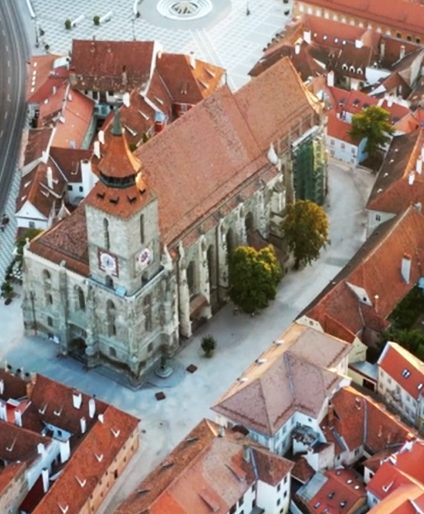
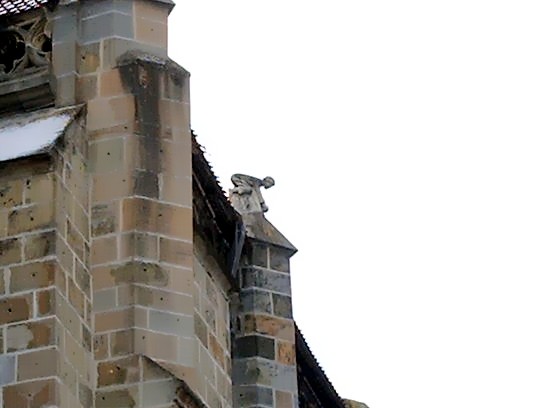
“He followed the smelly path of Schwarzgasse, its daily chaos giving way to night’s whispers. The street narrowed further, meandering past the imposing bulk of the Saint Mary’s Church, stone walls standing silent and cold against the dark. He hesitated, eyes flicking up to the roofline. The tale returned; of the boy who had climbed up there, foolish and brave, to retrieve a priest’s lantern or some lost dove, no one could agree. He had fallen. Some said he slipped. Others, that the roof rejected him.”
(When Secrets Bloom, Patricia Furstenberg)
For a writer, this matters. Real locations like Brașov offer more than visual accuracy—they provide narrative logic. A city built through interruption teaches characters how to survive interruption. A city shaped by shifting power teaches them how to read uncertainty in others. Even the streets carry that instruction: narrow, enclosed, branching from a central square like veins from a heart that has had to keep beating through centuries of pressure.
The suburbs, too, matter in this structure. Historically distinct zones—Saxon, Hungarian, Romanian—once described in relation to one another like separate breaths within the same body. This is not simply geography. It is social choreography. Movement through the city becomes movement through identity.
And fiction thrives in that tension.
In When Secrets Bloom, walking through such a city is never neutral. Every step crosses an invisible archive.
He thought of the quaint Jewish district with its modest houses and the tiny Prayer House; a room, actually, tucked in the Rabbi’s home that was stuck behind a tall fence, so hidden it was almost non-existent.
“He thought of the quaint Jewish district with its modest houses and the tiny Prayer House; a room, actually, tucked in the Rabbi’s home […] Compared to it, the Saxon quarter loomed in his mind with its grand constructions and structured society, with sturdy stone buildings and spires casting sharp shadows no matter the time of day. He remembered its maze of narrow, winding streets designed for defence, the fortified walls that spoke of people accustomed to guarding their own. The Saxons, with their guilds and organized trade structures, lived a life that seemed as impenetrable as their stone houses. Moise […] had seen them in their bustling markets, and witnessed the influence they wielded over Kronstadt. He thought how each group kept to its own, bound by traditions and rules.”
(When Secrets Bloom, Patricia Furstenberg)
What Brașov offers, ultimately, is not just authenticity, but density. A place where administrative records, guild privileges, fortifications, fires, and reconstructions all coexist without resolving into simplicity. It refuses simplification. That refusal is what makes it useful to storytelling.
Because secrets, in such a city, are not hidden in one place.
They are distributed — between walls, under courtyards, inside renamed streets, beneath churches rebuilt over older foundations or near defense walls. They bloom slowly, like something that was never meant to be fully exposed.
And that is where fiction enters—not to correct history, but to listen to what it could not say aloud.
Beautiful journey through the history of Brasov!
My greatest pleasure, Diana. I love Brasov, have so many good memories there.
A breathtaking tribute to the living history of Transylvania. By describing cities like Brașov not just as locations, but as vessels of memory, you elevate travel into a form of archaeology. The imagery of centuries settling like bark perfectly captures that unique, stoic beauty of a place that has watched the world change while remaining firmly rooted in its own story. Truly evocative writing.
Thank you, Sofia. Yes, Braşov is a multilayered city that never ceases to amaze you. It was exciting and rewarding to include it in my book.
I appreciate your visit.
A fascinating post, Patricia. I’ll link it to the post about When Secrets bloom.
Roberta, Thank you! What a wonderful idea.
I love this postings especially because I enjoyed finding authentic locations and using them in my book.
What a fascinating place! I realise that I really don’t remember much of Eastern European medieval history from school, but I remember hearing about Kronstadt. Brasov looks like a great place to explore the past.
I just downloaded When Secrets Bloom. Looking forward to reading it.
So many places in Transylvania are suited to exploring the past on foot 🙂 Brasov, Sighisoara, Sibiu…
Thank you, Cathie. I know how busy you are. Do enjoy the read!