The road curled around the valley like a silk ribbon that time itself could have dropped. And maybe it did. It was up to me to pick it up and discover where it will lead.
Here, the air was sharper. The mountains, closer. And somewhere, beyond those horizon, lay treasures. The bony kind: of dinosaurs, of Roman legions, of medieval monks, and of a church whose walls had been painted, hen erased, and painted again by generations who (foolishly?) believed their moment in history would last forever.
Was it possible? It felt as if one moment I was driving through modern Romania while the next I had slipped through a seam between centuries.
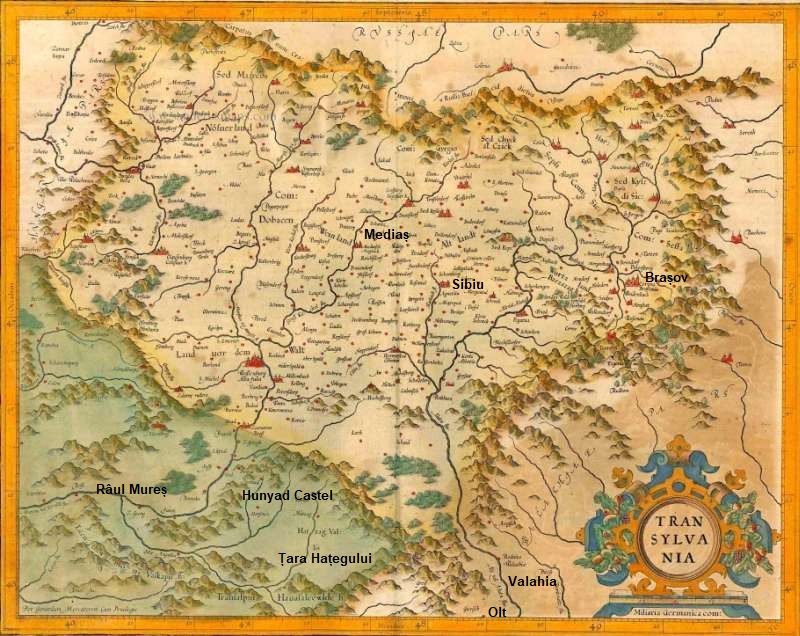
Where? In Țara Hațegului, Hațeg Land
I was in Țara Hațegului, the historical land saddling the curve of the Carpathians, a place where – as I was to find out – time was reluctant to move on.
Here, the Carpathians rise around it like a protective ring. To the south, the jagged Retezat Peak looms through forests and glacial lakes. To the north and east, the softer ridges descend into fragrant orchards, fields, and sprinkled helmets where hay still dries on wooden racks. The valley is caressed by rivers that trickle between poplars and meadows as if in no hurry to reach the outside world.
Yes, here, time turns at another pace.
Yet reaching this valley has always required effort.
Arriving from the south one must pass through its natural gates: the Iron Gates of Transylvania with its ragged cliffs that lean toward each other – in conspiracy? But the secret, back entry – the one known to few – is over Merișor-Bănița Pass, from the north. A pass that winds through dark forests. Only the brave one cut their path through fog that clings stubbornly to the slopes. But once reaching the lowlands the entrance into the Hațeg Land is almost ceremonial.
Yet, however one arrives, the effect is the same. The valley opens slowly, revealing a land layered over and from stories.
To start with, seventy million years ago this peaceful countryside was a tropical island rising from a warm sea. Because volcanoes smoldered here already. And strange creatures — dwarf dinosaurs found nowhere else in the world — wandered its forests.
In 100 An came the Romans. They carved their roads and built their cities that, today, still sleep beneath the soil.
Then the medieval communities developed, raised stone churches surrounded by tall walls that endured Mongol and Ottoman attacks.
All in all, Hațeg Land lived through wars, empires, and the quiet erosion of centuries. And here are two of the oldest churches in Romania, Densuș and Sântămăria Orlea. What is certain is that they were both built on millennial consecrated ground.
Yet no knowledge of history prepared me for the moment when I first lay eyes on:
What to see? The church of St. Mary Church on Orlea Hill, Sântămăria-Orlea
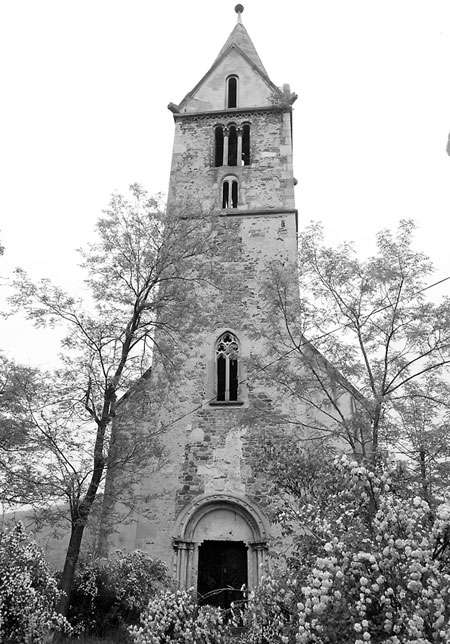
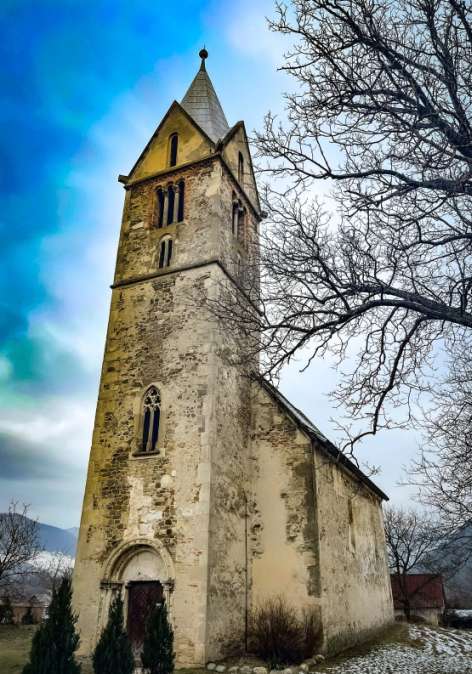
The quaint village appears without warning: fields bordered by fruit trees give way to a sprinkle of houses. Clean walls, low roofs, yards at the back where I spot the tops of orchards trees. A barking dog announces strangers. Then the church rises from the grass, taller and older than the village itself. One of the oldest stone churches in Transylvania.
The village of Sântămăria-Orlea was first documented in 1331 as villa Sancte Marie. Back then the Cândea / Cândești family(name changed to Hungarian Kendeffy during Reformation) owned a rather large area of that land. Nicolae Cândea was the head of the clan. We know that his son, Mihail of Râu de Mori was killed in 1356 under the order of Andrei Lackfy, the first ruler of the Szeklers and Voivode of Transylvania.
The Cândea family were cneji (from cneaz, pronounced knyaz) a historical title for a local chieftain from the Vlach (Romanian) medieval community. Their powers and wealth grew with time (King Matthias Corvinus, the son of John Hunyadi, bestowed upon them aristocratic privileges in 1462. In 1782 they built the local Kendeffy Castle.
But we want to discover more about the St. Mary Church of Orlea, or Sântămăria (in Romanian), Liebfrauen (in German), Őraljaboldogfalva (in Hungarian). Don’t we?
The 13th century Church of Sântămăria Orlea
Some say that the Church of Sântămăria Orlea was built by Cistercian monks, or the White Monks, between 1270 – 1280 (or even 1243) and dedicated to the Virgin Mary.
The 12 cross an circle signs mark it as a Christian place.
So, at first, she listened to Latin hymns drifting like incense toward her wooden ceiling. Yet the church has a surprisingly large structure for such a small settlement — being the largest medieval church in the valley.
If you follow my blog, the Cistercian monks might sound familiar to you. In Transylvania the Cistercian monks are most closely linked to the 13th-century Cârța Monastery, near Sibiu — the easternmost reach of their order in Europe. Known as the “White Monks” for their austere way of life, they played a significant role in shaping the region before the monastery was dissolved in 1474.
As such, the design of the Church of Sântămăria Orlea is almost austere: thick stone walls, narrow windows (although neatly framed in stone), a tower that seems less decorative than watchful. Undoubtedly the Church of Sântămăria Orlea displays the natural transition from Romanesque (the southern portal) to Gothic architecture (first floor window) found in so many constructions in Transylvania.
But the church also bears silent witness to centuries of (forced) religious and cultural change in these Romanian lands. Because the church has remained in continuous use for over seven centuries, a testament to enduring faith and the blending of Western, Byzantine, and local traditions within its walls.
It is inside, though, that the stone walls begin to speak.
At first the walls bore only simple painted crosses, apparently 12, marking its Christian consecration.
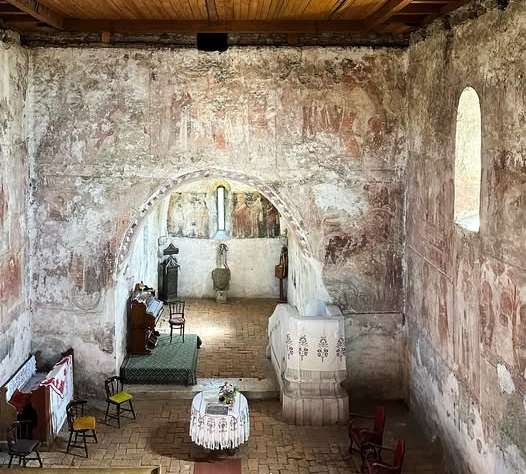
By 1311 more murals are added. The artists returned with pigments and brushes. They covered the interior with frescoes: solemn saints, biblical scenes, and patterns where Byzantine grace met medieval imagination – which are rare to have survived in Central Eastern Europe and have never been restored.
Among the most striking Byzantine murals are the scenes from the life of the Virgin Mary, the Last Judgment, and a beautifully rendered Saint Nicholas (dated 1311). Yet it is the Elevation of the Holy Cross that feels truly unique: Saint Helena and Patriarch Macarius of Jerusalem stand on either side, supporting the Cross as it is lifted before the tomb.
The murmur of Byzantine chant, rich and low, brushed her walls covered with saints in red and gold.
Then came another turn in faith.
When the church became Reformed, after 1555, the paintings were hidden beneath layers of lime. Whitewashed. Silenced. Documents attest that on 8 March 1559 Reformed Priest Martin already preached here for four years.
Reformation impacted the lives of all denominations living in Transylvania, and for many centuries, but this is a story for another time. A Reformed psalm took shelter beneath her ribs. She did not protest. She had learned early that God understands many languages.
For generations the saints of the Church of Sântămăria Orlea slept beneath plaster.
Today the frescoes have begun to breathe again. Conservators have peeled away the lime in places, revealing figures that seem to emerge slowly from the stone itself. In some corners the newer Byzantine paintings have faded, exposing an even older layer beneath.
Within her nave, apostles stride in solemn procession. Saint Nicholas watches from the southern wall, stern yet kind, as though guarding both shepherd and scholar. Saint Helena lifts the Holy Cross with quiet determination. Above them all faded consecration crosses whisper of hands long turned to dust.
Standing there in the cool dim interior, I felt as though the walls were telling their own history: one belief painted over another, yet never entirely erased. The first Christians, the Cândea / Kendeffi lords once leaned from their western balcony, proud as falcons. Italian Catholics still slip inside when the door creaks open. Seven Reformed families gather once a month, their voices light but resolute.
Outside, the valley lay quiet.
A cart rattled along the road.
Wind moved through tall grass.
Here, the centuries had not quite finished speaking. And it struck me then that Hațeg Country is not merely a place to visit. It is a place where time lingers, turns on itself like a gust of wind. It’s a land where volcanoes cooled into mountains, dinosaurs into fossils, Roman roads into village paths. And where a small church in Sântămăria-Orlea continues to hold the memory of them all.
I stayed a moment longer in the cool shadow of St. Mary Church of Sântămăria-Orlea, letting the time settle around me.
Places like this do not merely show their past; they invite us to imagine the lives once lived here: the monks who first raised the walls; the villagers who gathered under these stone arches; the travelers who arrived weary, through the mountain passes, to find shelter beside this church.
I stood and let the stone speak to me. The old church listens to them all. Stone does not quarrel. Stone remembers.
In 2026 St. Mary Church of Sântămăria-Orlea was included in the 7 Most Endangered programme launched in January 2013 by Europa Nostra and supported by the Creative Europe programme of the European Union as part of the network project Europa Nostra Heritage Agora.
A beautifully written post! So lyrical, so evocative.
I am so glad you enjoyed it, Anna. And I appreciate you stopping by.
Beautifullly written post, Patricia. I love visiting places which seem to belong more to the past than the present, like this one.
Yes, such places are magical, Blanca. One could easily slip through time.