
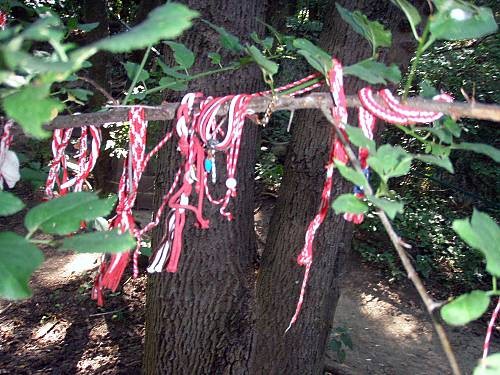
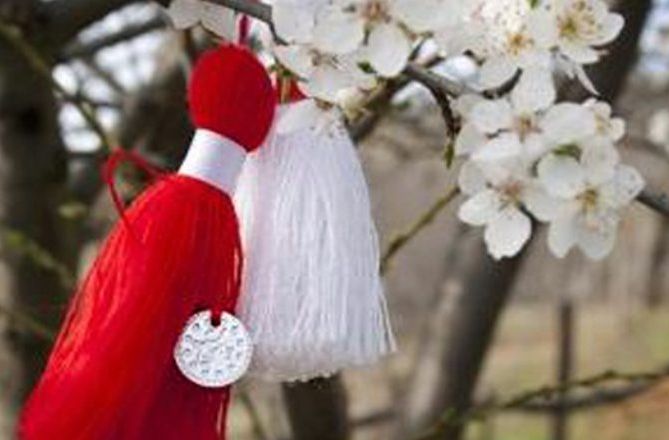
Red and white color my thoughts well ahead of 1st of March. In the Romanian tradition, on the first day of spring (in the Northern hemisphere), twined together, threads of red and white spring forward on Mărțișor day, quiet yet insistent. Unassumingly simple. Deceptively small. A charm no heavier than Spring’s first breath.
But red and white are never accidental. They’ve followed humanity across centuries and continents like faithful companions.
So why do red and white spell Spring?

Red is history’s oldest story. It is the color of blood and, therefore, of survival.
“So the arrow grazed the outermost flesh of the warrior [Menelaus], and forthwith the dark blood flowed from the wound. As when a woman staineth ivory with scarlet, some woman of Maeonia or Caria, to make a cheek-piece for horses, and it lieth in a treasure-chamber, though many horsemen pray to wear it; but it lieth there as a king’s treasure.” (Honer, Iliad, IV., 7th cent. BCE))
Archaeologists have found red ochre scattered in prehistoric burials as if our ancestors believed even the dead should not travel unmarked by vitality. Perhaps they used it to simply mark the grave site or to tan the clothes of the deceased. Or maybe that ochre was used as body painting in special rituals.
Truth is, red calls attention.
Red warns and protects, it refuses invisibility. In folk belief across Eastern Europe, red wards off the evil eye. It is vigilant, not gentle.
White, by contrast, carries the silence of snow. The secrecy of bone. The sanctity of life-giving milk.
White symbolizes both purity and vulnerability.
White Lily is Saint Mary’s flower. White lily is believed to be the first flower to ever be cultivated by humans and is associated with purity. Archangel Gabriel is also depicted offering Virgin Mary white lily after the birth of Baby Jesus. A newborn child is often wrapped in white cloth, entering the world unblemished yet vulnerable.

As vulnerable as winter fields are when they lay exposed beneath a grey sky. Yet, in contrast with red, white does not shout, nor does it fight; it reflects. It invites light. Meditation. Knowledge.
Braided together for Mărțișor, on every 1st of March, red and white, white and red, enact a dialogue: life and stillness, heat and frost, pulse and pause. Because early March in the Carpathian lands knows precisely this duality. Winter has not relinquished its claim. Beneath a thawing ground, life hesitates.
The red-and-white thread mirrors the landscape itself, it marks the moment that borders dormancy and awakening.
Why? Perhaps because red and white also symbolizes the most fundamental image of human existence: blood against skin, heat against ice, life fighting mortality.

These two colors, together, remind us that renewal is never abstract. It is seasonal. It is fought for. It is earned.
Of course, today, color psychology confirms what folklore knew all along.
Red stimulates, it heightens emotion, it accelerates the heartbeat. White infuses clarity, renewal, it suggests possibility.
While combined, red and white contrast enough to imprint on one’s memory. That tiny string braided on first spring day is visually magnetic because the human brain is wired to notice high contrast signals, especially resembling biological cues.
Yet this powerful pairing is older, and wider spread that any Romanian tradition.
Before the Roman civilization, the Greeks used bold colors such as red to symbolize violence and death. Clytemnestra dreamed of Oreste, represented as a snake:
“sucked her milk, clotted with blood” (Aeschylus, The Oresteia, 5th cent. BCE)
Later, in ancient Rome, priests used white garments edged with red during purification rites. In Roman wedding rituals the bride wore a red (by all appearances) veil called flammeum, symbolizing fertility but also an infula, a red-and-white crown.
Across time and cultures red and white often signaled a threshold—moment when something was ending and something else began.
In neighboring Bulgaria, the Martenitsa tradition mirrors this same chromatic union while in Japan, red and white symbolize good fortune, protection and auspicious beginnings.

The genius of Mărțișor lies in its fairness. It asks not for a belief system. It makes a stand: winter and spring coexist for a time. Vitality and life grow out of stillness and death.
I like how in an age measured by algorithms this red-and-white braid feels almost defiant in its restraint. It’s not a trend. It ‘s a return. It is its repetition that engraves its meaning. Each March we see the same two colors and something inside us stirs. It shifts. Our bodies remember the red-and-white before our minds get a chance to do it.
Each March we witness how red waits and white listens. While spring negotiates between them.
Happy 1st of March! Happy Spring Day!
Excellent information on the history of a colour. Thanks for sharing, Patricia. 🙂
The Mărțișor, 1st of March tradition is very close to my heart. I grew up with it. I always wondered why the red and the white in the string 🙂
I did not know about the March tradition. Happy Spring
It is a lovely tradition still followed in Romania 🙂