

In medieval Transylvania shoes were more than mere protection… Yes, like almost everywhere in the world by that time. In medieval Transylvania shoes were markers of identity, status, and survival.
From the jeweled silk slippers of Byzantine-inspired nobles to the sturdy leather boots of peasants navigating the Carpathians, each step in medieval Transylvania tells a story. During my research for writing When Secrets Bloom I took great care to look into local fashion and customs. I had to reflect the rich tapestry of Transylvanian cultures: Romanians, Saxons, Székely, and Jewish communities. Because each held (still holds) its own distinctive style yet all were subtly shaped by the lingering influence of the Hungarian Empire of which Transylvania was part of for eight hundred long years) .
So join me and let’s follow these historical footprints. Let’s explore how fashion, necessity, and artistry met at the crossroads of empire, trade, and local tradition.
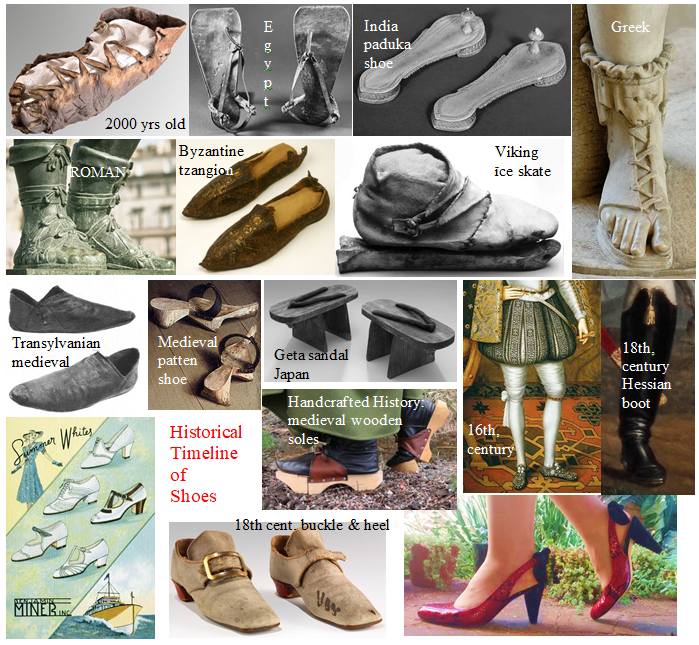
From Hides to Sandals: The First Footsteps of Footwear
The story of shoes begins deep in prehistory. Scraps of leather, woven fibers and sandals discovered in caves and deserts are all that remain of those early footsteps. The oldest pair apparently (10,000-year-old sandals from Oregon) along with woven shoes from Missouri and hide wrappings from Denmark show that care for protecting one’s feet was as ancient as the hunt and the hearth. With time, materials shaped the design. Hides softened in Ice Age Europe, yucca and plant fibers were woven into sandals of Americas. Each step took shows a balance between survival and a hint of craft. Even without dyes or ornament these shoes carried not only bodies but human lives in the first rhythm of survival.
Sandals of the Gods: Greek Steps in Leather and Myth
In ancient Greece many still went barefoot. That’s why sandals, shoes, and boots carried immense meaning; not only protection but status even divine symbolism. Shoemakers worked leather into endless varieties: sturdy crepida sandals for laborers, delicate ankle boots for women, tall buskins with cork soles for actors, or gilded or dyed shoes for the wealthy. While Spartans scorned footwear as weakness, others flaunted it as identity. Some sandals, with engraved soles, even left messages in the dust. Myth itself enshrined shoes: Hermes with winged sandals, Aphrodite in golden ones. It still reminds us that to walk, in Ancient Greece, was not only to move but to declare who you were. It meant status.
From Constantinople to the Carpathians: Byzantine Echoes in Early Romanian Footsteps
Byzantine footwear, though often hidden beneath long robes, blended Roman practicality with Eastern splendor. Glimpses at church murals or mosaics show silk embroidered with gold, buttoned with jeweled accents carrying bling echoes of Middle Eastern craft. Adapted from Roman sandals and shoes such footwear gleamed in Constantinople’s marble halls. It even left their mark in Moldavian monasteries where Byzantine influence endured in frescoes, textiles, and ceremony. Yet beyond such luxury of empires the Carpathians knew the tread of simpler, sturdier boots: of hide wrappings and fur-lined shoes worn by migrating peoples across snowed forests and lush plains. When I think of these boots I see the thick woods and wide plains of early Europe. The same leather soles that once crossed the Carpathians, long before Wallachia and Moldavia were formed, still left their mark centuries later.
In this meeting of empire and steppe, opulence and endurance, early Romanians inherited both traditions: the ornate pride of Byzantium status and the hard-worn resilience of the nomad survival, an unbroken lineage of footsteps from Constantinople to the Danube.
Footwear of the Middle Ages
Medieval shoes changed in step with Europe’s shifting tides. Early post-Roman barbarians wore simple, practical leather shoes. But by the late Middle Ages fashion had grown whimsical and extreme. Early shoes were stiff leather, stitched and tied, sometimes lined with fur in the north. They were made to endure long journeys and harsh winters, much like the boots worn by hardy communities in the Carpathians centuries later.
When I think of medieval shoes I imagine the Crusaders returning from the Middle East, bringing not only spices and silks but also pointed slippers, the first crackowes or poulaines.
By late fourteenth century such shoes had long, upturned toes that sometimes stretched 60 cm ahead of the wearer. To keep their shape they were supported by delicate chains or stuffed with hay or whalebone. They were a statement of wealth, leisure, and fashion, showing that the wearer could indulge in beauty over utility. Clergy and conservatives called them “devil’s fingers,” and even kings tried to regulate their length by social class.
These extravagant shoes emerged in the wake of the Black Death, when survivors sought joy and flamboyance in clothing. Both men and women supported and extended the style, pushing the limits of imagination and comfort.
When I think of medieval shoes I see the same blend of luxury and survival across Romanian lands. Wallachian voivodes, Moldavian princes and Transylvanian nobles mingled with Polish and Hungarian visitors, adopting fashions carried by merchants and crusaders. While peasants still trudged the forests and mountains in simple leather boots.
At the same time, Byzantine influence lingered. The glint of jeweled silk shoes from Constantinople echoed in Moldavian monasteries, their art and ceremony preserving that opulent spirit. In this single landscape, extremes of creativity and necessity coexisted, bound by leather, laces, and the enduring human desire for both protection and pride.
Following the path of shoes from the Hungarian Empire into medieval Transylvania
At the dawn of the medieval period, craftsmanship was largely rural and peasants made and repaired their own tools, furniture, and shoes. True artisanal specialization existed only on large estates or in monasteries, where craftsmen – often servants or slaves – produced shoes, saddles, armor, and other goods under organized supervision. But by 11th century many rural craftsmen moved to towns, forming professional associations, guilds, that divided labor into specialized trades. These guilds regulated quality, upheld economic rights, and they soon helped shape the urban landscape forcing the shift from survival-focused, homemade footwear to shoes that reflected skill, style, and social identity.
In Transylvania’s fortified towns, guilds were more than trade associations. They were guardians of the community. Each major guild oversaw a tower, responsible for weapons, provisions, and the upkeep of fortifications, and its members trained as soldiers to defend the town. The Shoemakers’ Tower in Sighișoara, standing since 1522, is still a striking example. Rebuilt after the devastating 1676 fire caused by stored gunpowder, it incorporates Baroque architectural influences from the late 17th century, a testament to how the strength of a guild lasted and rested in both its craft and its collective discipline.
Near Brașov’s fortress, at the foot of Tâmpa Mountain, two watchtowers were built in the 15th century. They connected to the citadel by a line of walls that extended toward the mountain ridge. The Shoemakers’ Tower was one of them.
“Left and right of the Magistrate, Moise discovered several of the city’s most influential men; the heads of guilds: the Goldsmiths, of course, the Furriers, the Rope Makers, the Tanners, and even the Weavers.”(When Secrets Bloom)
Today, visitors can still see the platform where the tower once stood and much of the base of the connecting wall that once crossed the mountain, a reminder of the guild’s presence and defensive role.
True, for in medieval Transylvania shoes were more than protection. They were markers of identity, status as well as survival. To me, they evoke the worn paths of mountain passes, each leather and wooden sole carrying centuries of footsteps, bearing the marks of history as surely as the paths themselves.
To the Hungarian Kingdom, Transylvania was a land of forests, rivers, and fortified towns. The streets, like those of Buda, bore witness to both practicality and prestige: side-laced ankle boots kept wearers steady on cobblestones, while colorful embroidery and fine leather quietly announced their rank. Across the towns of Kolozsvár (today Cluj-Napoca), the towers of Alba Iulia, and the hills around Sibiu, sandals, ankle-shoes and ankle-boots jostled for prominence. Richer classes favored imported hides from Bulgaria, while the humble worked simpler leather or felt. Nobles in Turda could walk beside merchants and artisans, each step marking survival and hierarchy.
Yet shoes in Transylvania (as everywhere) were never purely practical. They carried the memory of history as well as the shadow of danger. In the narrow Carpathian passes footwear could conceal a weapon… instruments of readiness, even self-defense:
“The dagger. Forged not just for a woman, but for me. Lord Vlad’s gift… I slipped it into my boot, its weight a comfort.” (When Secrets Bloom)
While, in fortresses, the wooden pattens (wooden soles) could reveal a presence when least desired:
“Stone buildings leaned in—silent sentinels or spies? Lately, I had felt searching gazes everywhere. And tonight, my wooden soles betrayed me, clattering against frost-slick cobblestones. Each misstep a warning. Each sound, a threat.” (When Secrets Bloom)
Shoes also carried subtle signals of menace or spectacle. In town squares and forest clearings, a figure’s shoes could tell a story before the rest of him appeared:
“At the centre of this page stood another man, a Locator… Shoes with bells completed his attire.” (When Secrets Bloom)
From Transylvanian passes to the castles of the Hungarian Kingdom, from the streets of Alba Iulia or Kronstadt (today Brașov) to the hills surrounding Sighișoara, footwear marked the boundary between practicality, prestige, and peril. Shoes bore history on the feet, carrying status, secrets, and stories across centuries, across empires, and along the shadowed paths of Transylvania itself.
As such, footwear in medieval Transylvania was not defined solely by long boots. Lighter shoes were also common, ranging from sandals that covered only part of the foot, often decorated with delicate cutouts, leather straps, and buckles, to more elegant shoes with anatomically shaped soles and a narrowed midsection for a refined silhouette. These shoes appeared in various styles, from simple versions to those adorned with gemstones and metal clasps.
Toe shapes fell into three main categories: normal, widened, or pointed—and sometimes exaggerated, as in the poulaines (Schnabelschuhe) that dominated much of the 15th century. Pointed shoes became popular alongside the short, fitted clothing of the 14th century, when shoes became more visible compared to earlier periods, when long garments concealed them.
By the end of the century, protective overshoes (Schuh mit Trippe) were also in use. Made with thick wooden or cork soles and secured with a strap, these covered the shoes beneath to protect delicate footwear or hose from snow, mud, and other hazards of everyday life
From Poulaines to Sneakers: Four Centuries of Fashionable Footsteps
From here and into the nineteenth century European shoes mirrored shifting ideals of beauty, power, and practicality. The pointed poulaines of nobles eventually gave way to broad-toed sturdiness, then to the flamboyant extremes of the sixteenth century: duck’s bill shoes and towering Venetian chopines that turned walking into performance.
By the seventeenth century, ribbons, buckles, and rising heels transformed shoes into glittering emblems of status, while cavalier boots embodied swagger and authority. The nineteenth century brought refinement and innovation: women’s dainty buttoned ankle boots and men’s polished Wellingtons graced salons and streets, while Goodyear’s vulcanized rubber quietly launched the age of sneakers. In these centuries, every step was a declaration of wealth, fashion, or modern invention.
From Pumps to Punk: Footwear in the Twentieth Century
The twentieth century transformed shoes from necessities into symbols of fashion, identity, and innovation. Early decades (1900–1918) introduced right- and left-foot shaping, rubber heels, and the rise of the women’s pump and men’s oxford, while Converse’s 1917 All-Stars announced the sneaker’s arrival. By the 1920s–30s, women embraced glamorous pumps, T-straps, and peep-toes, while men sported oxfords, wing tips, and spats.
Then, the Depression and World War II shifted focus to durable, rationed materials and military boots. Postwar optimism revived elegance with stiletto heels, polished loafers, and playful plastics, while the 1960s–70s saw rebellion and experimentation: go-go boots, Birkenstocks, Doc Martens, and Nike’s waffle-soled trainers reshaped style from counterculture to mainstream. By the 1980s–2000s, shoes embodied both power and leisure: patent leather pumps in boardrooms, trainers as global fashion statements, and platforms, cowboy boots, and Mary Janes carrying nostalgia into modern wardrobes.
Across the century, shoes carried the weight of survival, the signals of status, and the marks of culture, blending practicality with spectacle at every step.
From humble leather boots to jeweled silk slippers, shoes of the world and in medieval Transylvania served more than for protection. They were markers of survival, status, and identity. Across streets, castles, and mountain passes, footwear reflected the blend of practicality and spectacle that defined the era, imprinting culture and hierarchy on the fabric of history.
“Her family was part of the renowned weaver’s guild that sold their rugs as far as the Sultan’s palace and as far as Vienna.”(When Secrets Bloom)
Sources:
Medieval pattens image source Handcrafted History: https://handcraftedhistory.blog/2020/09/06/medieval-pattens-research-post/
Fashion, Costume and Culture by Sara Pendergast and Tom Pendergast, Vol. 1 – 5
Medieval Taylor’s Assistant by Sarah Thursfield
Bresle si Arme n Transilvania (Sec. XIV – XVI), Ioan Marian Tiplic
About the research:
Patricia Furstenberg is a Romanian-born historical fiction author whose Blood of Kings, Heart of Shadows series explores medieval Transylvania, Wallachia and Moldavia. Her research takes her into the history, folklore, landscapes and forgotten stories behind the fiction.
As a person who loves shoes, I found this information very fascinating. Thanks.
Yes, I enjoyed all the research just as much 🙂 Thank you for visiting, Darlene.