
There are stories that refuse to stay in one place. They move through empires and forests, from the hills of Rome to the endless grasslands of the steppe, carried not in stone, but in memory and blood. Again and again, across distant peoples, the same figure appears: not crowned, not tamed, but wild: the wolf.
From the White Wolf and the Lupercal cave in Rome, to the wolfish-blood origin of the Mongols, the She-Wolf Asena ancestry of the Turks and, of course, to the fearless Zalmoxis and the Great White Wolf of the Dacians let’s follow the wolf.
The White Wolf Ancestry of Romans
Before Rome had emperors, it had a cave.
On the slopes of Palatine Hill lay the Lupercal, a rocky hollow with a spring and a sacred fig tree, a place that felt claimed long before the city rose around it. The earliest people there likely held the wolf in a strange balance of fear and reverence. When the Romans came, they did not erase that presence. They kept it.
At the heart of Rome’s founding story, the wolf is not decoration. She is everything.
In the oldest tellings of Romulus and Remus, the abandoned twins do not survive by chance. A she-wolf finds them, feeds them, and guards them with an authority that feels almost divine. Humans arrive later, as if stepping into a story already claimed by something higher.
Only with time did Rome soften this image, turning the wolf into symbol or explanation. Yet traces of the older belief remained. The festival of Lupercalia, held at the very cave, hints at it, a ritual that never quite decided whether the wolf was to be driven away or honored.
Beneath Rome’s marble and order lies this earlier truth: the city did not begin solely with men, but with a creature of the wild—one that nurtured its founders and was never fully forgotten.
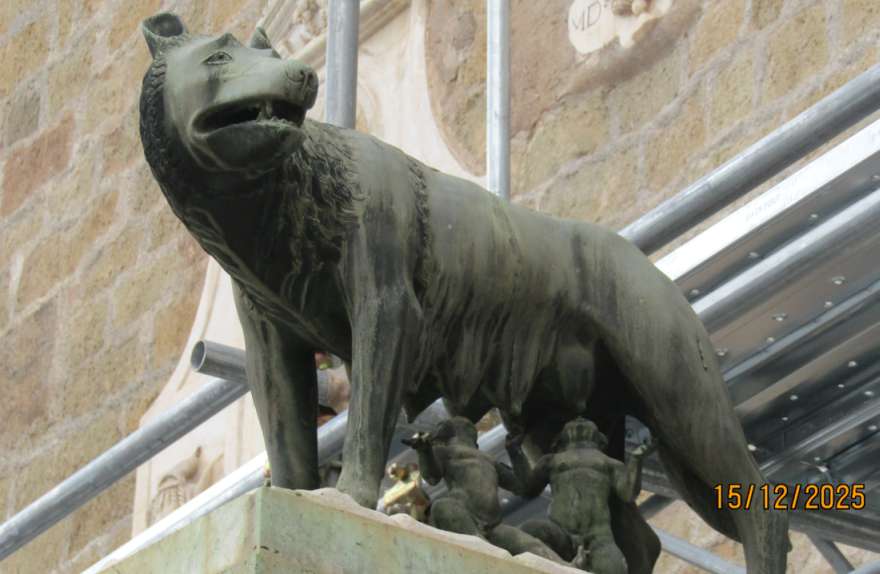
How the Wolf Walks with the Steppe: Mongols and the Blood of Origins
If Rome half-remembered the wolf, the peoples of the steppe never forgot.
Across the vast grasslands—where horizons stretch like drawn blades and the wind carries stories farther than any road—the wolf was not a symbol to be softened. It was ancestor, guide, and omen. Among the Mongols, the bond was neither hidden nor reshaped into gentler forms. It stood at the very beginning of who they believed themselves to be.
The opening lines of the Secret History of the Mongols do not speak of kings or cities, but of a blue-grey wolf, its destiny ordained by Heaven itself. This wolf, paired with a fallow doe, crosses the great waters and settles beneath sacred mountains, where the first human ancestor is born.
From that union—wolf and deer, sky and earth—emerges the lineage that would one day produce Genghis Khan.
Here, the wolf is not merely a forebear but something closer to a divine intermediary. In Mongolian belief, wolves are bound to the Eternal Blue Sky, emissaries of a higher will. To encounter one is to brush against fate itself—to feel one’s destiny sharpen, expand, awaken. The creature is both omen and measure: to see a wolf is fortune; to overcome one is to claim something greater still.
What defines this tradition is its refusal to diminish the animal. Where more settled civilizations reshaped their older beliefs into safer, more human forms, the steppe held fast to a harsher inheritance—one in which identity could rise from the wild without apology.
And so the wolf—blue-grey beneath the open sky—remains what it always was. Not a symbol carved into stone, but a living ancestry carried in story, in blood, and in the unbroken memory of those who never sought to tame it.
The She-Wolf Asena: The Wolf Ancestry of the Turks
Among the ancient traditions of the steppe, the Turks did not claim descent from kings or gods—but from a wolf.
The story begins in destruction. A lone boy survives the fall of his people, left wounded and abandoned. A she-wolf finds him, feeds him, and keeps him alive. In time, she becomes more than his savior—she becomes the mother of a new lineage.
This she-wolf is known as Asena.
Driven into hiding, she flees to a remote mountain cave, where she gives birth to ten sons—beings of both human and wolf nature. These sons grow, step into the world, and from them the early Turks trace their origins. One lineage, the Ashina clan, rises to power and lays the foundation for the first great Turkic empire under leaders such as Bumin Qaghan.
What makes this story striking is its clarity. The wolf is not a symbol added later—it is the beginning. Asena remains present in the enduring image of the Bozkurt, the grey wolf, a figure of strength, survival, and fierce independence.
In this tradition, the wolf is not something to be feared or explained away. It is remembered as ancestor—wild, watchful, and never fully tamed.
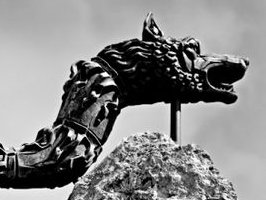
Zalmoxis and the Great White Wolf of the Dacians
Beyond Rome’s borders, in the shadowed forests of the Carpathians, the wolf was not just a guardian of myth—it was the soul of a people.
The Dacians, who stood against Rome in bitter wars, carried the wolf into battle itself. Their standard—a living banner of fear—bore a wolf’s head with a serpent’s body, its hollow form screaming in the wind as they charged. To their enemies, it was terror. To them, it was identity.
Some even believed their very name meant “wolves.”
At the heart of their belief stood Zalmoxis, a god both distant and watchful. Over time, legend bound him to something more immediate, more wild: the Great White Wolf.
This was no ordinary beast.
Once, the story tells, he had been a man—a priest devoted to Zalmoxis, wandering the land, guiding his people. The god, seeing his worth, transformed him into a creature of immense power: a white wolf, vast and unyielding, tasked with gathering all wolves under his command.
And they came.
From every forest and ridge, wolves answered his call. When danger threatened, a single howl would summon them, a living storm of teeth and fury, defending the Dacians as brothers. Yet the White Wolf was more than protector—he was judge, turning against those who betrayed their own.
In time, as Rome’s shadow crept closer, something broke. Fear took root among the Dacians themselves. Some turned against the wolves, hunting them, hoping to save themselves through betrayal. And so the bond shattered.
The wolves fled. The Great White Wolf withdrew with his god into the mountains. And when the Romans came, the Dacians stood alone.
What remains is not just a legend, but a memory of kinship lost. For the Dacians did not merely admire the wolf—they believed they stood beside it, and, once, were worthy of its call.
Thus, across Rome, the steppe, and the ancient forests of Dacia, the wolf appears not as a monster to be feared, nor merely a symbol to be admired, but as something closer to origin.
A guide.
A guardian.
A beginning.
And perhaps, in every retelling, we are not just remembering the wolf.
We are remembering what it meant — once — to belong to the wild.
Yet some stories do not begin in books at all, but at a hearth. A short story:
“Mother told me of the Roman she-wolf who suckled Romulus and Remus, founders of their eternal city. Of Genghis Khan, who claimed the grey wolf as forefather. My lord spoke of the Turkish she-wolf whose milk saved the line of the Blue Turks.
Power traced its blood to fangs before it ever bowed to crowns.
But it was the Dacians, first dwellers of these forests around Kronstadt, who held wolves closest. Calling themselves Daoi, wolf-like, their standard bore a wolf’s head fused to a dragon’s body. It shrieked in the wind as they charged. Death, to them, was no ending but a passage. To fall in battle was proof of immortality.
As you, my lord, had seemed immortal in war.
Such faith unsettles rulers. Nothing threatens dominion like a people unafraid to die.
Her stories rose with the scent of baking cozonac, sweet Christmas bread heavy with grapes dried from our garden and walnuts saved for winter. The crust darkened in the oven; the air thickened with fruit and warmth. I would steal a fistful of filling into my apron and listen, chewing slowly so the tale would last.
Now, I speak those stories to my dog and sole companion, Wolf. Stories untold wither. They belong to him as much as to me – our bloodlines braided in these woods.
Outside, wind scraped at the walls. Inside, embers breathed red, holding back the dark for the sake of the man on my pallet. Wolf rested his head against my chest, solid and certain.
Mother’s tale began in a time when villages were only clearings and trees were kin. The forest sheltered those who honored it.
As it had sheltered me.”
Excerpt from a previous WIP version of my upcoming historical fiction novel Beneath the Snow – following Kate, Iancu and Moise’s story from When Secrets Bloom. Yes, and Vlad Dracula’s mysterious past too…
~~~TO BE CONTINUED~~~
About the research:
Patricia Furstenberg is a Romanian-born historical fiction author whose Blood of Kings, Heart of Shadows series explores medieval Transylvania, Wallachia and Moldavia. Her research takes her into the history, folklore, landscapes and forgotten stories behind the fiction.
They have a reproduction of this statue outside a fancy restaurant near Rome, New York, where my family used to go from time to time, and when I was little it always weirded me out because I didn’t understand what it was or why it was there lol
Oh, dear! But I can relate.We were told her story in primary school history, as part of Romania’s ancestry. Still, the image was unsettling for a child.